Malt, Mould, or Saliva

Göran Winarve drying malt on Gotland, Sweden in October 2023. |
Michael Jackson famously classified beer into ale and lager based on how it was fermented, but this is a rather superficial feature. What defines beer and sets it apart from other alcoholic drinks is that it's made from grain, which contains no sugar. Making mead from honey, cider from apples, or wine from grapes is far simpler than brewing beer, because the sugar is already there. With beer, however, you need to convert the starch to sugar first, and the need for this step is what defines beer as a drink.
If you first accept that the definition of beer is that it's made from grain something else follows, too. Beer then stands out because it's made from the crop that has been the food base of society basically since the end of the last Ice Age. Beer is the drink that's made from a crop that humanity has had masses of, unlike fruit or honey. This is why beer has been the drink of the common man, and it's why beer has been such a huge economic force. It's also why beer has been the drink of the northern peoples: you can grow grain up to the Arctic Circle, but not grapes.
But if the definition of beer is that it's made from grain, then it follows that Asian drinks like sake and huangjiu are also beer, despite being made from rice. (Huangjiu isn't always, but never mind.) Similarly, South American chicha also becomes beer, since rice and maize are both grains.
Once you zoom out like this, the distinction between lager and non-lager becomes pretty trivial. The key step in beer brewing is saccharification, turning starch into sugar, and there are three different ways to do that. Which means there are three different kinds of beer.
The beer we are all familiar with is based on first sprouting the grain to create enzymes for breaking up the starch, then immersing it in hot water to make the enzymes break down the starch into fermentable sugar. First malting, then mashing. But this isn't the only way to do it.
Some microorganisms have figured out how to get at the energy stored in grain by breaking down the starch themselves, and you can exploit these organisms to do the job for you. This is how Japanese sake is made, for example. The rice is steamed, and then koji, a starch-breaking fungus, is added, together with yeast. The koji then breaks down the starch to sugar, while the yeast ferments it to alcohol, with both processes running in parallel, unlike in European-style breweing.
The third way is decidedly more exotic. Humans can also break down starch — that's how we get energy from eating bread and pasta and so on. So another way to get the sugar is to chew the grain, which mixes it with spit containing the necessary enzymes. You then spit the chewed grain out and wait, letting the enzymes do the job. Chewing enough grain for a meaningful batch of beer is a lot of effort, but it does work.
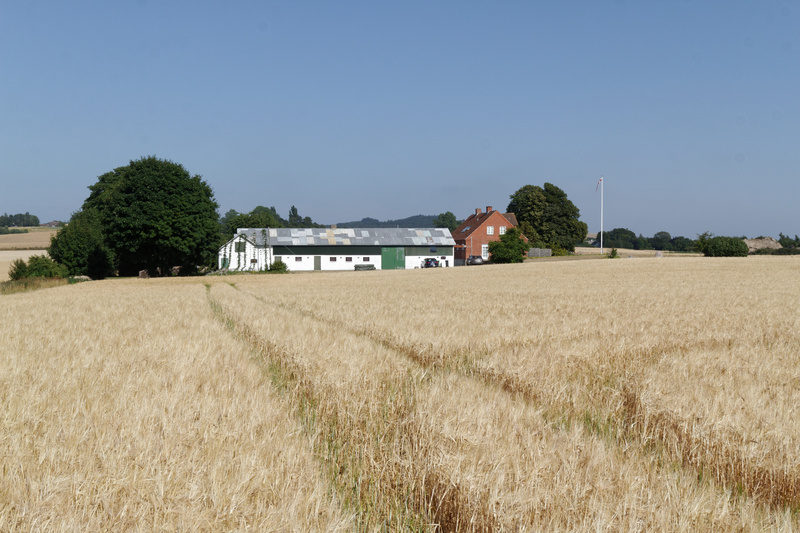
Barley field on the island of Møn, Denmark. |
History
Malting and mashing is, as far as anyone knows, the only way that beer has ever been made in Europe. In fact, one of the oldest archaeological finds of beer in Europe is from Hornstaad-Hörnle, in present-day Germany, on the border with Switzerland [1]. This find is dated to 3910 BCE, not long after beer brewing began in this part of Europe.
Interestingly, analysis of the starch grains in this beer show evidence of malting. So apparently people were using the same method already then. In fact, the oldest beer find of all, from Raqefet Cave in present-day Israel, shows the same: the starch grains have damage characteristic of malting and fermentation [2]. So apparently this method has been in use since 11,000 BCE, which means it's probably been used since the very beginning.
It's not just the Japanese that use fungi for saccharification. In fact, all of East Asia does the same thing. The Chinese, the Koreans, the Philippine, the Indonesians, the Indians, the Burmese, ... The oldest beer find from this part of the world is from Qiaotou in southern China, dating to roughly 7000 BCE [3]. And what do you know ... analysis of the starch grains finds damage characteristic of fungal breakdown of starch. So apparently the Asians have been using fungi since the very beginning.

All the data I have on what saccharification method was used where in modern times. |
As you see from the map, Eurasia appears to have been divided in two. In the west everyone used malting and mashing. In the east (almost) everyone used fungi. Egypt and Mesopotamia both used malting, so apparently the dividing line between these two worlds runs somewhere between Mesopotamia and India. Maybe Afghanistan and Pakistan was the border? Unfortunately, the arrival of Islam killed off brewing in this part of the world, so it does not appear to be possible to identify exactly where the border once was.
Now, why would east and west be so different so consistently, over such huge stretches of time and space? In fact, what we are looking at here is two separate, independent inventions of beer. The Natufians (probably) invented brewing in the Middle East some time before the invention of agriculture in the same region. The ancient Asians invented brewing from rice, then afterwards figured out how to grow rice. In both cases the practice of agriculture then spread out over huge areas, and the knowledge of brewing travelled with it.
So, apparently, people in each area invented one brewing method, and then just stuck with it for millennia afterwards. Everyone knew this was how beer was made, and that was that. The fact that people on the other side of the continent did it a different way never seems to have registered.
Except it's not quite that simple. As far as I know, the Asian method was never known in the west, but malting must have been known in the east. Barley and wheat were domesticated in the Middle East when agriculture was first invented, and agriculture based on these grains spread eastwards into Asia. Eventually, it made it all the way to, for example, Japan. The knowledge of malting and mashing must almost inevitably have travelled with these grains. Or at least it had the potential to, if people wanted to know.
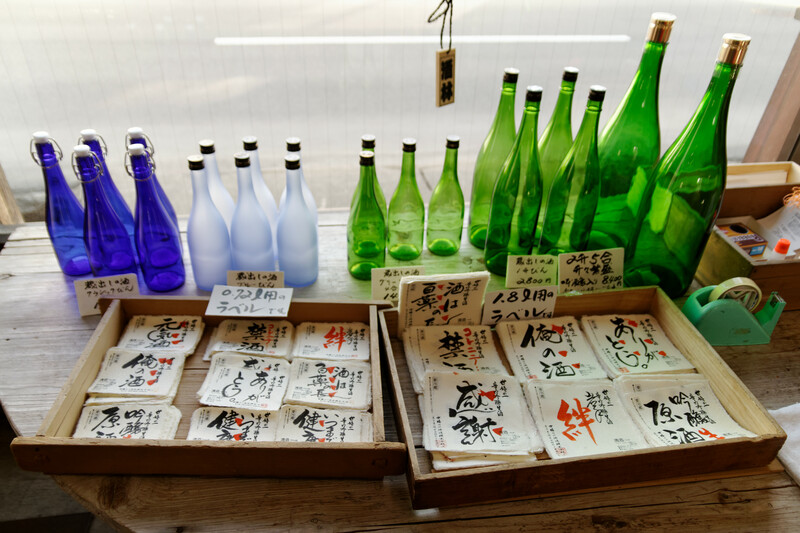
Not-yet-filled sake bottles in a window at Sekinoichi Shuzo sake brewery in Ichinoseki, Japan. |
There are actually traditional brewers who malt and mash in China (blue dot far north on the map), although that seems to be very rare. There are references to malting and mashing in medieval Japanese texts as well [4:41]. So clearly the Asians knew about malting, but they stuck to their own method anyway. Why? Well, malting is a lot of work, and it takes a long time. If you use fungi they basically do all the work for you. So why bother with malting? The Asians appear to have decided they wouldn't.
Of course, there are breweries such as Tsingtao and Sapporo in East Asia who use malting and mashing, but as the above makes very clear, these are not Asian-style breweries. All the Asian lager and craft brewers are imports from the West that arrived in the last couple of centuries, and have largely displaced the much older indigenous brewing methods. Sake and huangjiu are still made, but today they are pretty small in volume compared to the Western-style brewing.
The Origin of Agriculture
Having thought this far the obvious next step is to realize that agriculture has been invented more than twice. What did the other inventors of farming do?
Farming was invented somewhere in West Africa around 4000 BCE, and just like in the Middle East, once farming had been invented the farmers spread out, taking over the continent south of the Sahara. In fact, if you look at a map of the language families of Africa you can clearly see this expansion in the distribution of Niger-Congo language family (the Bantu languages are part of it).

Map of the major language families of Africa, by User:SUM1, Wikimedia Commons. |
And what saccharification method did the Africans choose? They chose malting. African farmhouse brewing is still based on malting (visible in the same dot map as Eurasia), and I've seen no sign of other methods anywhere on the continent.
If we turn to South America, maize growing began in southern Mexico around 7000 BCE, and spread into South America from there. Chicha, an indigenous farmhouse ale based on maize, is still brewed over much of South America. Two methods seem to be used: malting and chewing, and today malting seems to be by far the most common. As far as I know, the only people practicing chewing are Indians in the jungle. It's tempting to suggest that this means chewing was the original method in South America, but there is no evidence either way that I am aware of. I might have missed something, though.
Agriculture was also invented at least once in North America, and there was indigenous brewing there as well. The Apache, for example, brewed their tiswin from maize malt.
Another invention of agriculture happened on Papua New Guinea, but, amazingly, the people there seem to never have invented alcohol production in any form. At least that's what all ethnographic sources I've seen claim [5][6][7]. This despite them growing sugarcanes. So in this case there is no saccharification at all.
What's With the Asians?
So, out of the five different cultures we've been able to study, four chose malting, and one chose fungi. Why did the Asians choose a different method from everyone else? Well, their agriculture started with rice. It's possible to sprout rice and turn it into malt, but most rice varieties do not give enough diastatic power to actually convert the starch into sugar efficiently [8][9]. The Asian sources I've seen mentioning malting all refer to other types of grain. So probably malting rice simply did not work for ancient Asians. (It looks like people are beginning to find rice varieties that can be malted now, though [10].)
In other words, the Asians probably couldn't choose malting. They may have used chewing in the beginning, because there is evidence for that method in Asia as well. In the Ryuku islands people were chewing rice as late as the 19th century [4:28], and the method is also mentioned in medieval Japanese texts [4:26]. But based on the Qiaotou find it appears that most Asians pretty quickly transitioned to using fungi, or maybe that's how they started out.
The Evolution of Beer
What I find really striking about this is that it appears that five different cultures all independently found a way to brew beer, and then, having found a method, they just stuck to it for millennia. To me this is a striking illustration of how beer brewing was never really consciously designed. It just evolved, and people accepted whatever method they inherited as given and inevitable. Much like farmhouse brewing, in fact.
More Data
I promised myself never to dive into farmhouse brewing outside Europe, but at the same time I'd love to have more data on this. Do you know of a source that describes traditional brewing in some specific location outside of Europe? If so, I'd love to see it. Please send by email or add to the comments below.
References
[1] Mashes to Mashes, Crust to Crust. Presenting a novel microstructural marker for malting in the archaeological record. Andreas Heiss et al, PLOS ONE, May 7 2020.
[2] Fermented beverage and food storage in 13,000 y-old stone mortars at Raqefet Cave, Israel: Investigating Natufian ritual feasting. Li Liu et al, Journal of Archaeological Science: Reports, 2018, vol 21, p783-793.
[3] Early evidence for beer drinking in a 9000-year-old platform mound in southern China. Jiajing Wang, Leping Jiang & Hanlong Sun, PLOS ONE, 16(8): e0255833, 2021
[4] Kanpai — The History of Sake. Eric C. Rath, Reaktion Books, 2025.
[5] The use of home brew in Pacific Islands countries and territories, Vili Nosa et al, Journal of Ethnicity in Substance Abuse, 17:1, 2018.
[6] A history of prohibition and liquor legislation in Papua New Guinea, Mac Marshall, IASER discussion paper, number 33, 1980.
[7] Alcohol and Public Health in 8 Developing Countries, Leanne Riley and Mac Marshall (eds), World Health Organization, WHO/HSC/SAB/99.9, 1999.
[8] Insight Into Ancient Egyptian Beer Brewing Using Current Folkloristic Methods, Hideto Ishida, MBAA TQ, 39:2, pp81-88, 2009.
[9] Experimental Studies To Obtain Rice Malt, Elena L. M. Ceppi and Oreste V. Brenna, Journal of Agricultural and Food Chemistry, 58, 2010.
[10] Malted Rice Is on the Rise, Joe Stange, Craft Beer & Brewing, 2025.
Similar posts
The Yeast Family Tree Grows
A few years ago I wrote about the groundbreaking study (Gallone et al 2016) that for the first time gave us an idea of how the different types of brewers yeast are related to each other
Read | 2021-10-26 10:39
Nordic grog
The origins of beer brewing in Scandinavia are lost in the mists of pre-history, and today we have very little evidence of how it began
Read | 2015-02-09 20:44
A maltster on Gotland
While on holiday on Gotland I saw a note on a poster about an open farm and something about malt being made
Read | 2017-01-01 14:02
Comments
Rob Sterowski - 2025-12-03 17:39:48
One thing you didn’t mention is that East Asian cultures do a lot of sprouting of beans, which is essentially malting.
Can a drinkable alcoholic beverage be made from mung or soy beans? I don’t know.
Sergey Konstantinov - 2025-12-03 22:54:05
Why Asians stick to using koji is understandable - it's easier and produces stronger beverage. But why Europeans don't use it remains largely a mystery to me. Koji works with barley and wheat as well; and rice was cultivated in Europe in significant quantities since late Middle Ages. Still, no attempt to produce Baijiu in Europe was ever recorded, to the best of my knowledge — unlike, let's say, tea or silk.
Lars Marius Garshol - 2025-12-04 09:07:04
@Rob: I didn't mention that, because I wasn't really aware of it. It's a good question whether beans could be mashed and then fermented. My guess would be that diastatic power is probably too low, but I don't know for sure.
In Europe people have malted peas and used them in beer together with malted grain. You'd imagine that if the alcohol potential in beans were high enough to be usable, someone would have started using them at least with fungi.
Lars Marius Garshol - 2025-12-04 09:11:17
@Sergey: It's a good point that rice was grown here already from the Middle Ages. I think the reason why fungal saccharification didn't catch on can be seen today. We know perfectly well in the West today that we could use fungi, but in practice nobody does, except to make sake. (Well, the brewer at Bygland Bryggeri has done some cross-over experiments. Some of those were actually excellent.)
I guess it's a double barrier. The whole concept is just totally alien to how we think of beer. How do you even start composing a recipe? And the supply chain is just completely missing. How would you go about ensuring sufficient supply of koji to regularly brew a koji-based beer commercially?
And if you did succeed, how would you sell your new beer to customers? You'd need to do a five-minute tutorial before they'd even understand what it is.
So I guess I can see why this hasn't been done.
Sergey Konstantinov - 2025-12-05 13:45:51
@Lars: while I agree in general, smth still doesn't add up. Late Medieval/Early Modern Europeans invested a lot into adopting Chinese technologies (porcelain, paper, lacquerware, etc.), even quite impractical ones (including cultivating mulberries and tea), but somehow not baijiu. I agree that it is partially because of habits and the lovable taste, especially today when the cost of production is negligible compared to excises, but at the same time Europeans readily adopted alembic (obviously because it emits stronger alcohol, not for its superior taste) and chocolate (which was also initially not very palatable but fashionable).
Richard Preiss - 2025-12-06 01:57:53
There are a good number of YouTube videos documenting traditional West African brewing methods (based on malted sorghum, millet etc). While not academic text, these practices have not died out so you can lean on contemporary sources like YouTube.
Lars Marius Garshol - 2025-12-06 10:54:31
@Richard: I do use Youtube videos as sources for my research on European farmhouse brewing, but I haven't yet found any videos of brewing outside of Europe. Thanks for the tip! I'll see what I can find.
Lars Marius Garshol - 2025-12-06 14:11:30
@Sergey: You make good points. I don't really know why koji was never adopted in the West. There could be any number of reasons, really, and without more data I guess we will never know.
Ross - 2025-12-06 23:48:37
Saliva based starch conversion is also found in some South American cultures. Chicha beer made from chewed corn is known enough to be able to find references to it online. I presume that there are other less documented variations.
András Borbíró - 2025-12-08 16:56:47
Great and interesting writing as always! Thank you.
I have just read about making mezcal. It ends in distillation (putting it outside the scope of this blog), but for making mezcal, starch conversion to fermentable sugars also involves enzymes - but then cooking too.
It never ceazes to amaze me how resourceful people were in order to make alcoholic drinks.
Sergey Konstantinov - 2025-12-08 17:03:50
@Lars My hypothesis is:
1) During Middle ages, advantages of koji-fermented drinks were not that obvious (before distillation, baijiu should have contained around the same ABV as wine, ~10-12%). Given the two civilizations barely touched each other (Islamic countries in-between would make it highly impractical to trade beer or weak baijiu), so basically Europeans didn't know about baijiu and had not had any reason to invest in its production 2) In Early Modern era, Europeans were already familiar with distillation => again no strong reason to invest into baijiu trade => no trade, no urge to acquire this technology
If we add there the reluctance to share the details of the technology and the fact no people living in-between could provide those details, it was enough to just drop any attempts.
All these ^ are just my wild guesses; haven't seen anything credible ever written on the topic.
Alec Story - 2025-12-08 21:22:58
I'm a hobby specialist in ancient and medieval alcohol in China and have a few answers for you :)
I think a misconception that's causing confusion for you is that rice is the staple grain in China for all of history. This is not the case: China had multiple centers of agriculture, and the one centered around the Yellow River valley primarily ate wheat, barley, and millets. We see this in their alcohol too, as finds like mijiaya and guantaoyuan have barley present. Some of these sites have rice as well, but rice doesn't become prominent in northern China until something like 1000 ce when it displaces millets. Wheat is still typically preferred as the main grain in much of northern China: https://en.wikipedia.org/wiki/Northern_and_southern_China#/media/File%3AChina_agricultural_1986.jpg

https://beer-studies.com/en/world-history/Birth-of-brewing/Archaic-beers/Neolithic-China is a reasonable overview, but H. T. Huang's Science and Civilisation in China: Volume 6, Biology and Biological Technology, Part 5, Fermentations and Food Science is a much longer treatment on the topic, if a little old these days.
The older view was that the prehistoric (before ~1000 bce) process was *only* malting! But newer finds have driven back the development of the "mould" method (often called "Qu") back to the start of agriculture as well.
I'm very slowly translating a 544 ce northern Chinese farm manual that has many recipes for grain wine using the qu method, and interesting has a method for making malt, but only uses it to produce syrup for food purposes.
I think this comment will give you my email. Feel free to reach out if you want more info.
Rob Sterowski - 2025-12-29 18:29:34
It also occurred to me that brewing beer and baking leavened bread are symbiotically linked in northern and eastern Europe in a way they’re not necessarily elsewhere.
Not just the use of yeast to ferment both – “today I brew, tomorrow I bake” in the Rumpelstilzchen story (and the promise of the miller’s daughter to spin straw into gold seems like an allegory for making beer). Especially in the rye lands there are traditions of using malt to saccharify flour and flavour dough.