Europe's best-kept beer secret?

Vilnius business district at night |
A flood of industrial lager has swept away the native beer traditions of just about every country in Europe except, famously, for the Czech Republic, Germany, Belgium, and the UK. Oh, and, it turns out, Lithuania. If you haven't heard about Lithuanian beer traditions, don't worry, because nobody else has, either.
Other countries in Northern Europe also kept a native homebrewing tradition, as I wrote recently, but in these countries it is either hard or impossible to buy traditional beers. In Lithuania, however, the native beer is brewed commercially and available in a number of bars and shops. For anyone interested in actually trying it, that makes an enormous difference, because you can just buy a bottle without having to find and befriend a brewer first.
To make myself perfectly clear I should add that these are not the kind of craft brewers you find all over the world these days, making porters, doppelbocks, and IPAs. These people are brewing a style (or perhaps styles) I would call Lithuanian farmhouse ale.
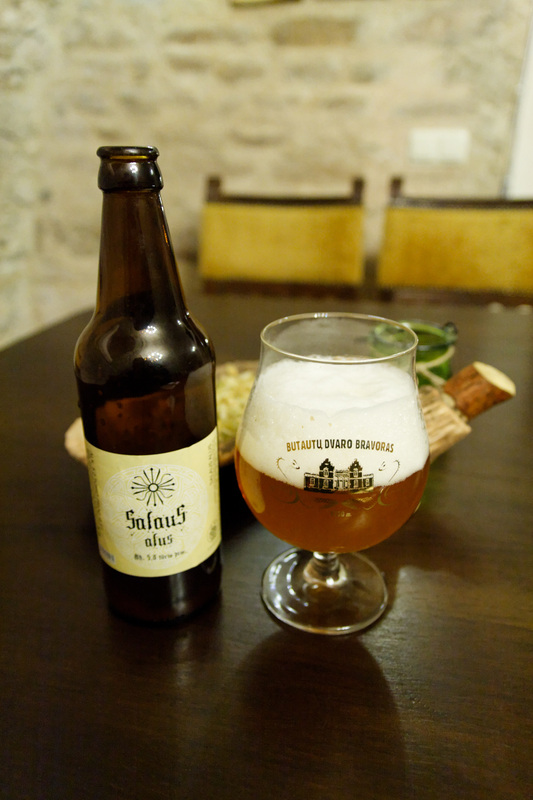
Salaus alus |
From Per Kølster's excellent book I gathered that brewing your own beer has never stopped being common in the Lithuanian countryside. Apparently, most brewers have their own yeast, which they keep in the well. It seems to be common to share it with your neighbours when they are in need, so to what extent it's possible to distinguish yeast strains is not clear. They also grow their own hops, according to both the book and locals, but what varietal (or varietals) I don't know. Even the malts are Lithuanian-grown, so this truly is a local product.
As you can tell, I haven't been able to find a lot of precise information on these beers. The reason is that I didn't meet a single person who knew about them who spoke fluent English, so extracting information was difficult, to put it mildly. And searching the web has so far yielded nothing useful.
In Lithuanian, this style of beer is known as "kaimiškas alus", meaning "village beer". It can be "šviesus", meaning pale, or "tamsus", meaning dark. Sometimes it's even "juodas", meaning black. Some are "filtruotas", lightly filtered, while most are "nefiltruotas", much less filtered. As I guess you've gathered by now, we are not talking about 2-3 beers here. RateBeer lists dozens of traditional Lithuanian beers, but in a few days I found at least 10 new ones, so clearly the true number is quite high.
I thought kaimiškas was a single style, but the beers are surprisingly varied. Some of the pale ones are fairly bitter and dominated by a dusty strawy taste, like being dropped face first into a bale of hay that's baked in the sun all day. Lithuanian beers appear to use lots of hops, and I suspect this is the aroma of the local hops. These beers have no trace of yeast character, surprisingly, but other beers are dominated by it. One tasted like a mild gueuze, another like a Belgian tripel, and a third was most of all like a Finnish sahti with a good dose of hops.
One I really liked was Jovaru Alus, at 5.6%. It was hazy and amber-coloured, and tasted of fruity walnuts and alcohol with herbal hoppy notes. It was both sweet and bitter at the same time, and a lot more harmonic than it sounds. I found it almost scarily drinkable. A more straightforward pale kaimiškas was Salaus alus at 5%. It was hazy and yellow with a huge white head, and tasted strongly of earthy peppery dusty straw. That taste was so incredibly vivid and clear I can still remember it fairly exactly. There was some sweetness, but mostly this was a bitter beer, with a long aftertaste that stayed in the mouth after I'd left the bar.
There is quite a lot to explore here, and since I've found no evidence of named styles, mostly one simply has to try beers at random to see what they are like. I really liked most of the ones I tried, and they were certainly a lot more interesting that the variations on industrial pale lager that are all most countries have to offer.
In Vilnius kaimiškas is actually quite easy to find, since there are several bars specializing in these beers. But that is a subject for another posting.
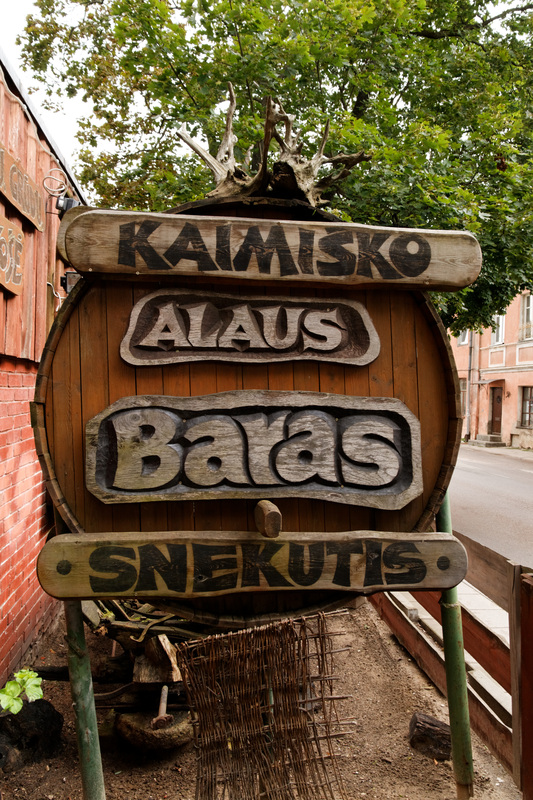
Kaimisko alaus baras |
Update: If you want more information I've published a guidebook to Lithuanian beer, which goes into a lot more detail.
Similar posts
Six favourite Lithuanian beers
After the blog posts about my Lithuanian beer tour Bryan D
Read | 2013-09-28 09:16
The beer bars of Vilnius
Lithuania may be a small country today, but once the joint Polish-Lithuanian Commonwealth included much of present-day Poland, Lithuania, Latvia, Estonia, Belorussia, and Ukraine
Read | 2011-05-14 10:40
Lithuanian beer, again
I've written before about how Lithuania has a beer tradition of its own, different from any other country on earth, but back then I didn't really know very much about it
Read | 2012-11-18 20:36