New Book: The Power of Beer
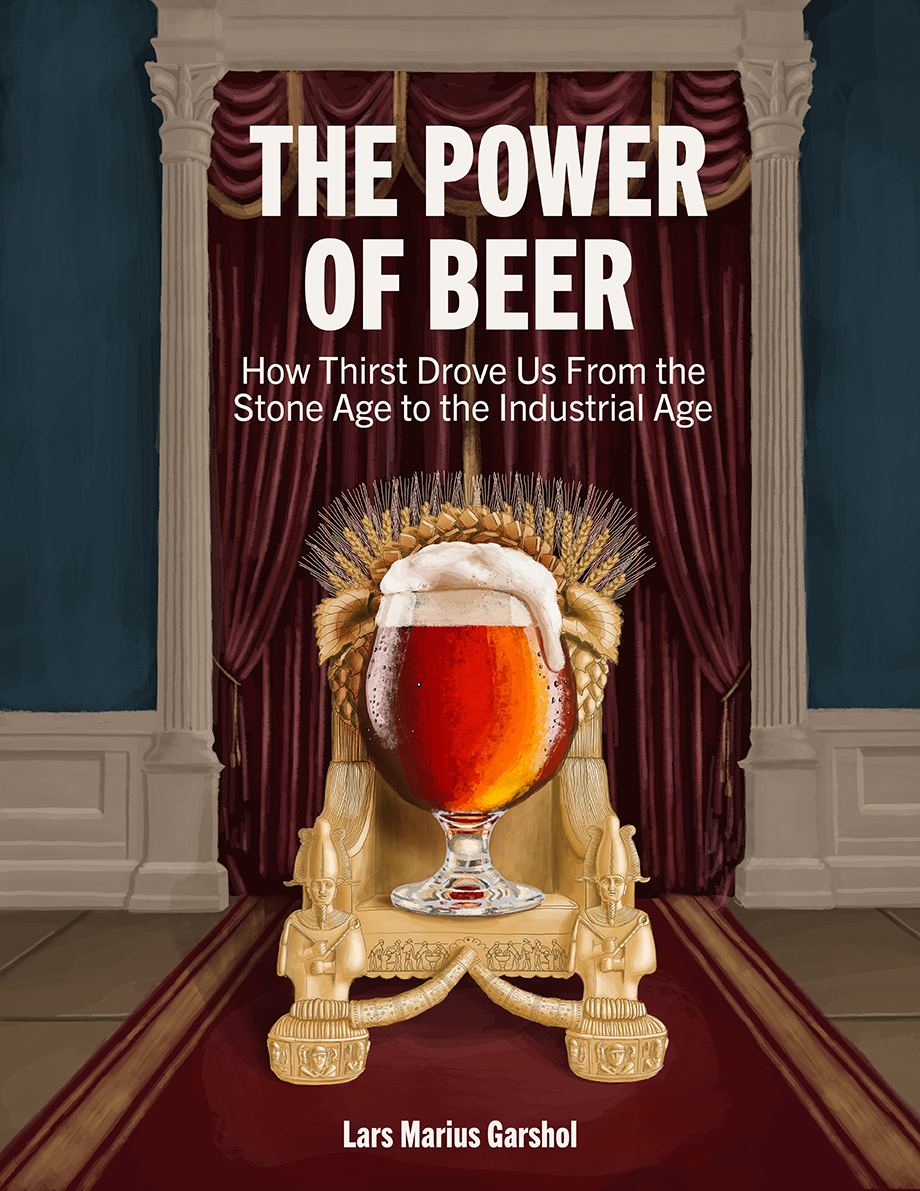
I'm finally out with a new book! In this case a history of beer, from the beginning until now. That's something entirely new from me, since it is not specifically about farmhouse ale, but this is a story I've been feeling a growing need to tell. Eventually the need to speak out became so overwhelming I just had to write it down, and here it is.
The title may seem strange, because what power does beer really have? As the book shows, when you look at the history of beer in the large the use of beer as a means to power is such a big theme that there is really no escaping it. So I decided to put that front and center.
What power am I talking about? Well, archaeology shows us that chieftains and rulers used opulent drinkware and costly drinks to impress subjects, warriors, and rivals. To take just one example, some Danish warlord apparently served drink from two drinking horns made of pure gold, and today the gold alone is valued at about 1 million USD. In the Iron Age even iron was precious, so the gold value back then must have been enough to make people's heads spin. And this was all done for political purposes, as you'll see. That is just one example in a very long list from prehistory.

Commodore Matthew Perry's second expedition lands in Japan to receive the answer from the Japanese. Note the modern marines with rifles and bayonets on the left compared with the samurai with swords and spears. Painting by W. Peters, US Museum of the Navy. |
An example from closer to our own time is the Japanese. They were shocked when in 1853 the US sailed a navy squadron into Tokyo Bay, demanding to be allowed to trade with Japan. Finding themselves entirely defenseless against such weaponry the Japanese reluctantly agreed, but also decided to reform their feudal nation defended by sword-wielding samurai into a modern nation. Half a century later their by now entirely modern navy and army defeated Russia in the Russo-Japanese war of 1905-1906.
To do this the Japanese required an enormous amount of money to reform their entire society, build new institutions and infrastructure, and so on. Where did they get the money? Well, in 1901 47% of the Japanese government's income came from taxes on sake brewing. (Full disclosure: in the earliest period of the reform government land taxes were their main source of income, but it was so harsh it caused riots, and was gradually replaced by sake taxes.)
In between those two there are many more examples, but I can't list them all here.
So is this book just about the use of beer to amass power? No. As I said, it really is a history of beer from the beginning until now, showing both how people related to beer and how they brewed it. It starts out by looking at when our relationship with alcohol began (before we became human), how beer brewing got started, and how it spread. But beer brewing started more than once, so the book also traces how the consequences of the multiple starts are visible today.

Cylinder seal from Akkad, roughly 2254-2218 BCE, with the inscription "Ur-Zu, the brewer". Shows a man offering a goat kid to a seated goddess, while the woman is offering something in a bucket, probably beer. Note the woman brewing on the lower left. Photo © 2008 Musée du Louvre, Dist. GrandPalaisRmn / Thierry Ollivier. |
There's also much more cultural background on things like whether people drank beer every day (yes, but also no), whether men or women brewed (complicated), beer in Egyptian and Mesopotamian mythology, beer in Viking society, and much more.
Part of the story is how the beer itself developed. The oldest brewing predates the invention of metal, and as we'll see that continued to affect how beer was brewed for thousands of years. When hops came into use turns out to be a surprisingly complicated story. The introduction of wort boiling is also covered, as well as when people first started drinking beer without bits of grain in it. Later, of course, comes lager brewing, and not much has been written before about how that began. Then things like filtering, cooling, and carbonation.
And then there is yeast, of course, which is a running theme throughout the book. That story looks nothing like what people are usually told. This is one of the reasons writing this book was so important to me: my view of the story of beer is very different from what people are used to hearing.

Drawing of a water ship bringing clean water to the breweries in some Dutch town. Drawing by Reinier Nooms, 1652-1654, Rijksmuseum. |
The other new thing I feel this book contributes is that it views the history of beer as a continuous development running from 11,000 BCE until now. So the different chapters connect to form a single narrative. It's a little bit tricky because there are multiple strands, but it runs something like this:
- Chapter 2: From our relationship with alcohol begins, until brewing has spread over much of the world.
- Chapter 3: Beer in Ancient Egypt and Mesopotamia, and how their beer cultures were highly developed, but also mostly died out.
- Chapter 4: Beer came to Europe before the rise of Egypt and Mesopotamia, as a separate tradition. We look at prehistoric rulers using spectacular drinking gear to amass power. Plus how they brewed.
- Chapter 5: The Vikings and their beer shows us how important beer was in prehistoric European societies, both politically and legally.
- Chapter 6: Towns begin growing, giving us commercial beer. The Hansa towns pioneer a new type of beer that causes major issues for Dutch rulers, how they adapt, and how this new brewing moves into Britain. The story of gruit, and also how beer created the Netherlands (no, really), and how women got pushed out of the industry.
- Chapter 7: How lager brewing began and took over Bavaria, then stagnated for centuries, and why.
- Chapter 8: We pick up the British story again, showing how the wars against France created porter, and how porter in turn made the UK the world super power (no, really). Then the story of IPA, including why they bothered transporting it half-way around the world.
- Chapter 9: How (and why) the lager stagnation suddenly ended, with lager exploding out of Bavaria to become a worldwide phenomenon in just a few decades. And how the British brewing of the previous chapter was crucial to the whole thing.
- Chapter 10: The lager giants succeed too well, so beer everywhere turned into nothing but samey pale lager. That made drinkers revolt, giving us craft beer. Craft beer famously began in the US, but the story turns out to be bigger than that.
- Chapter 11: While all this was going on farmers all over the world were brewing beers like those from chapters 4 and 5, almost as if commercial beer had never existed.
- Chapter 12: The not all positive developments over the last decade, and thoughts about the future.
Due to the economic constraints of self-publishing I had to be very economical with the text, so all this (and quite a lot more) is covered in 209 pages. Despite the book being richly illustrated.
I hope you will enjoy it.
More about the book, including where to buy it.
Cheers!

Drinkers in a tavern. Etching by J. Chérin, mid-18th century. Wellcome Collection. |
Similar posts
A new book on Topic Maps
Those of you who have been waiting for a new Topic Maps book will be happy to hear that one has just been published
Read | 2007-01-01 20:15
Amber Gold and Black — a review
Amber Gold and Black is Martyn Cornell's new book on the history of British beer, currently only available in self-published ebook form
Read | 2008-11-17 18:06
New Book on Norwegian Farmhouse Ale
I just sent to the publisher my academic book on Norwegian farmhouse ale, which summarizes what I've found in nine years of research on the subject
Read | 2022-09-15 13:33
Comments
No comments.