Spice in Farmhouse Brewing

Ivar Geithung in Voss applying meadwort inside the fermentor, as his father-in-law taught him. |
I started looking into farmhouse ale back in 2010, and one of the first things that struck me was that so many brewers were using juniper branches. By 2014 I had gotten more seriously interested, and had even visited brewers to see their brewdays, and started digging into what little literature there was on spice use. To my surprise, the literature was mostly focused on gale, and gave little attention to juniper, even though by now it was very clear to me that juniper was very important in traditional brewing.
Then, also in 2014, I got hold of the answers to the Norwegian ethnographic questionnaire on farmhouse brewing, and again I was struck by how just about everyone seemed to be using juniper in the beer. And by how few of the answers mentioned gale, in contradiction to the existing literature.
I started pondering how I could set the record straight, and quickly realized that I would need something better than "I have lots of sources, most of them say juniper, almost none say gale". But what? Eventually I hit upon the idea of making a database of the ethnographic questionnaire answers, and simply counting what herbs each answer claimed was used in brewing. That gave a pretty clear and convincing picture.
The questionnaire answers failed to cover some parts of Norway, however, so I started adding in my own interviews, as well as descriptions of brewing from sources like local history journals, books of local history, newspapers, and so on. Then I went to Stockholm and got hold of the Swedish questionnaire answers at the Nordic Museum. And some of the Danish answers. Then Estonian ones. And so on.

Questionnaire answers on Estonian farmhouse brewing at the Estonian National Museum in Tartu |
Today the database has 2490 individual accounts, totalling 11,561 pages of archive documents, and recording 43,115 data points. (The data covers much more than just what herbs were used.) I keep adding more and more data, and that made me constantly delay writing the paper on spice use, because I knew it would get better if I just waited a bit. Eventually I started wondering, "how long does it really make sense to wait?" I knew I'd eventually have to publish, and when I passed 1000 accounts describing spice use I told myself that now the time had come.
Now, 12 years after I started collecting data, the paper is finally out, in Ethnobotany and Economic Botany! The paper is here, but you need a subscription, unless you use this reader link.
In the end the paper was based on 1074 accounts. These come from 7226 pages of archive documents from archives in eight different countries, 104 interviews in nine different countries, and a pile of other documentation. For reliability I've only used sources that describe either a single brewer, or the brewing in a very small region, like a parish. And never more than three from the same region, even though I probably have at least twenty interviews from Stjørdal, for example. This is to avoid bias. Most of the data is from 1930 to 2025, but it describes brewing up to two generations before.

Map of all the sources, with interview sources in red, placed on top. |
People used to claim that farmhouse brewers used whatever ingredients were at hand, but this is not true at all. Farmhouse brewing was based on tradition, and the tradition dictated what ingredients to use. There might be some extra spice for specific occasions, such as Christmas, but this was very rare. Usually the beer was the same each time, although the strength might vary.
There are quite a few surprises in the data. One is how few people used no spices (1-3%). But perhaps the biggest surprise is how consistent the answers are from country to country. Only a single spice, bitter orange, is reported only from one country. And the number of spices in wide use is very low. Only three spices are reported used by more than 5% of accounts! These are hops (well, of course), juniper (no surprise), and alder. Yes, alder, the tree.

Table of spice use broken down by country. In this table absolutely all spices are included as long as the source says they were used, no matter if they are uncertain or it was rare. |
About 12% of accounts report pieces of alder wood being used, and in Norway and Lithuania about a third of the sources. It was also used to some extent in Sweden, Estonia, and Latvia. I brewed with Sverre Skrindo, and he used alder as you can see in the photos. Alder gives the beer a vivid red colour, and also adds astringency and flavour to the beer. If you can get hold of Bygland's Vasstrond'e you can taste it for yourself.
Gale is reported used in 5% of accounts, in Norway, Sweden, Denmark, and Estonia, but only in Estonia was use widespread (23%). However, as I was collecting data I felt that these figures exaggerated how common gale was, because a lot of these sources were uncertain about the gale use, or said it was in the past. (I'd made a rule to include every claim of use, no matter how vague or uncertain.) So eventually I added a second dataset where I only recorded spices that the source said were common to use. Going back through older accounts and adding that data took years. In that dataset gale use is at just 1%, and even in Estonia it's only at 5%. For comparison, juniper use was said to be common by 48% of sources.

Table of spice use broken down by country, only including the spices that the sources say were in common use. |
The remaining spices that stand out as having a clear tradition of use are Artemisia (a few different species), caraway (which was also used in some early porters), bitter orange, laurel leaves, and raspberry canes. Wild rosemary, St. John's wort, yarrow, and tansy were also definitely used, but by the time my data was collected use was rare, and the evidence for these is thin.
If we add in tobacco, pepper, and pea straw that basically covers all the spices that have been mentioned often enough to be worth discussing. And now I've included spices that are only mentioned in 0.4% of the sources, so I'm being very generous here. And that's perhaps one of the biggest surprises: very few spices are mentioned. There is a huge number of other spices that could have been used, and a huge number that various herbal sources claim were used, but there's very little solid evidence that any of them were used.
Modern brewers are used to boiling their spices in the wort, but only 26% of farmhouse brewers report treating their spices that way. By far the most common was to have them in the lauter tun (49%) or to make a tea/infusion with them (39%). It was only a few spices it was relatively usual to boil in the wort: hops (of course), bitter orange, laurel leaves, and tobacco. The three spices other than hops have something in common: they're all imported, and must have come into use fairly recently. That's probably why they were boiled in the wort, because wort boiling itself is fairly new. The other spices and their usage were fixed by tradition before wort boiling came into use, but not these ones.

Map of where juniper was used. |
One thing that is quite odd is that Norway stands out very clearly when it comes to juniper use. Both in that using it was much more common in Norway than anywhere else, and also that mashing with juniper infusion was much more common in Norway. Only Gotland, and to some extent the Estonian islands and west coast, are comparable, really. I have no idea why these regions are so different.
The data gives a clear impression that using herbs other than hops was more common in the past. A lot of the sources say they have heard about it, or people remember that spices used to be used, but that they no longer are used. And, certainly, in my own fieldwork I have seen very little spice use beyond the usual trinity of hops, juniper, and alder. Gale, once. Meadwort, once. And blackberry leaves, once. That's it, as far as I can remember.
Exactly why spice use declined I don't know. None of the sources say, except two that say using spices used to be more "fashionable". It seems likely that because hops are so easy to grow, and so effective against infections, they gradually replaced all other spices. That process started long ago, but it seems it was still not complete by the time ethnographers were recording how people brewed. Today it seems pretty much complete, though, except in Finland where only 64-65% of sources say hops are/were used.
That's a quick summary of what 12 years of compiling source material taught me about spice use in farmhouse brewing. There is lots more in the paper itself, so if you're interested I suggest reading that.
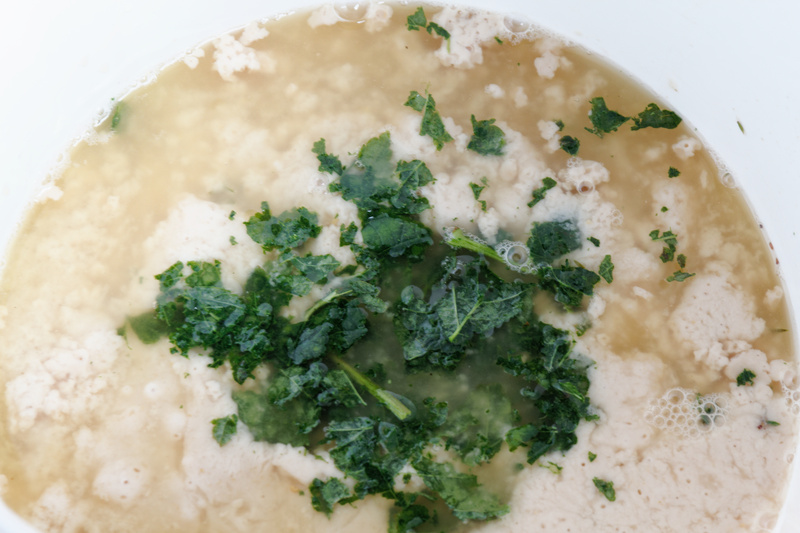
Blackberry leaves in the yeast starter on Hiiumaa, Estonia. |
Similar posts
The juniper mystery
When I started looking at farmhouse ale back in 2010, one of the first things that struck me was that nearly everyone seemed to be using juniper
Read | 2017-02-02 09:43
Apynys and Apynys
Until recently, the city of Kaunas in Lithuania was home to three breweries all named Apynys
Read | 2016-05-01 18:11
Puncturing the Gruit Myth
It's commonly said that "gruit is the beer that was brewed before people started using hops," and it's fascinating how many errors there are in that short, simple sentence
Read | 2026-05-18 20:01