Burnt out
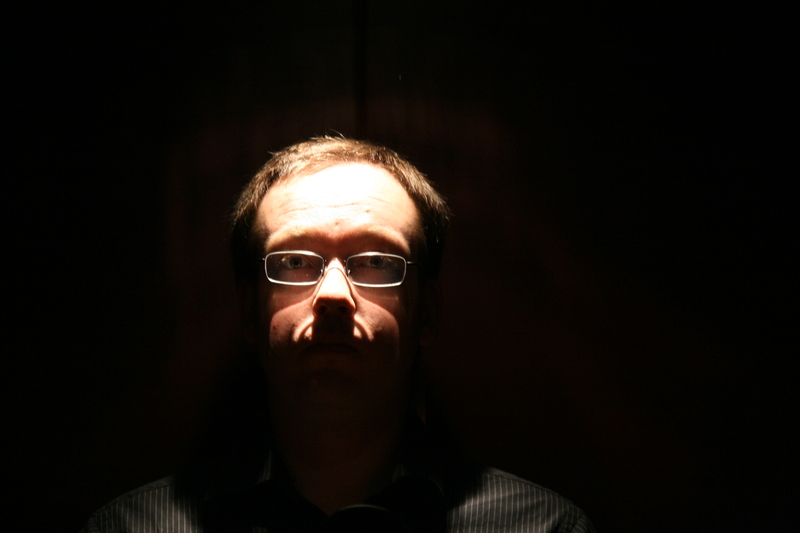
Self-portrait in elevator, Salzburg, Austria |
I never thought it would happen to me, but I guess they all say that. I knew I was pushing my luck, but I thought I always stayed on the right side of the line and that I'd be able to stop in time. What I didn't realize is that long-term stress wears you down gradually, and that if the effects don't get you while you're going at full speed they'll strike when you slow down.
Then, after it struck, I thought for a long time that I wouldn't write about it. There didn't seem to be any point, really. Talking to people about it, however, I've found that most seem to know very little about it, and at the same time want to know more. Another reason to write this is that there are some blog postings I want to write that may seem a little strange without this background being explained first.
The first time I can remember being so tired that I felt sick and nauseous and had to just stop what I was doing was in Tokyo in 2002, while sightseeing after two weeks of work in Japan and South Korea. Since then it's happened a few times, but I always responded by slowing down and taking it a little easier for a while, and this seemed to be enough for me to get by. Over the last few years this started happening more and more often, and it became usual for me to feel tired and out of whack. It got to the point where I stopped enjoying meeting new people and lost much of my interest in social activities. This happened so gradually that I didn't really sit up and take note.
Then, in December 2007, normal work started getting harder and harder and suddenly I found I could just barely get through a normal working day. Over Christmas I started getting ill in different ways. Normally I'm never ill, so this was a real wake-up call. My doctor found nothing wrong, however, which made us think this was a case of burnout. None of the people who know me well or have worked closely with me were surprised by this. My former manager said she thought I'd really burned out a couple of years ago, and that it only showed up now because I've been taking it easier after we were acquired by Bouvet. And I think she is right.
Anyway, the reaction of the managers at Bouvet was quick. I was told to start handing over everything I was working on, and to go see a specialist they use for burnouts. I sort of resisted and moved slowly on the handing over, but eventually realized that they were right, and that there was nothing else to do. As a result I've only worked one full week in 2008 so far.
So what is it like?
From talking to other people who have had this it's clear that this takes different forms, but common symptoms seem to be lethargy, nausea, headaches, pains in various parts of the body, and susceptibility to infections of various sorts. Personally, I contracted an ear infection, which was no fun, as I got a fever and the infection eventually made my ear drum burst. A month or so later I got an infection in my gums, which my dentist eventually had to cut up and clean with salt water. A friend of mine had none of this, but came down with a three-week headache instead.
One thing that was odd about the course this took for me was that once I stopped working and just took it easy I didn't start feeling better. Instead, I gradually got worse over the course of about a month, before I very slowly started climbing back.
I expected the quick transition from working 120% to doing nothing to be a real shock, and to be difficult to adjust to, since I'm just not used to taking it easy. Much to my surprise I found that it was not even remotely difficult. This was partly because I was too worn out to be able to do anything anyway, and partly because I really longed for some rest and found lazing around doing nothing to be exactly what I wanted and needed. Or at least I found it to be that way for one or two months. After that it started getting seriously boring, and in the last few months I've now and then found myself pushing myself further than I should simply because I haven't been able to bear continuing to do nothing.
Exertion
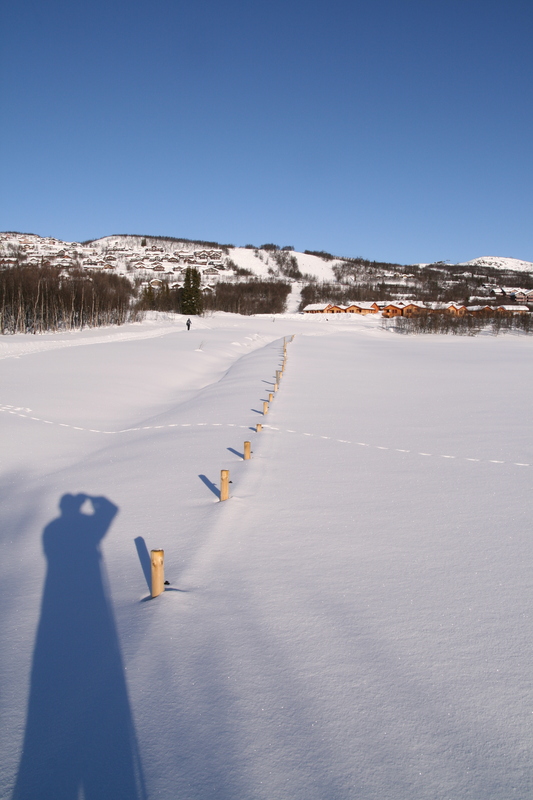
Fence, Beitostølen, Norway |
For some weeks I actually fell so low that I'd literally sit on the couch all day and do nothing except some reading. I'd force myself out for a 15-minute walk each day, and found this so tiring that I had to take the bus back home. After that I'd do literally nothing before the next day's walk.
Slowly I got better, and was able to expand the walks a bit, read more, and so on. I've also found that even if I feel totally whacked I am able to exert myself. We went away for a weekend of skiing, but because the last 100 km of roads were covered in ice, I wound up driving, which turned out to be tiring. So the day after I felt awful, and could barely get out of my chair.
Still, we'd come there to go skiing, and go skiing I did. We went at a quite leisurely pace for a couple of hours, mostly gently uphill. My girlfriend took it easy, while I'd cross out of the tracks into fields etc to take photos. I really enjoyed this and felt fine. Then we stopped for lunch, and when we were ready to get going again I felt completely knocked out. Even though it was all downhill back to the hotel I felt like I was only just able to make it. Once back at the hotel I did not get out of bed for the next 20 hours.
In other words, while down with burnout you can certainly exert yourself and be active. It's just that you have to pay for it afterwards. What I've also noticed is now that I've improved a bit in many cases I won't feel anything unless I stop what I'm doing and spend a few quiet minutes concentrating on how I really feel.
Is it just psychological?
Some people have asked me this, and it's clear from talking to the specialist that many people suffering from burnout wonder the same thing. The answer is that it's both physical and psychological. It's psychological in the sense that people who inflict this on themselves have certain bad habits and work values that cause them to push themselves too hard.
However, the effect of that is physical, in that some of the biochemical networks in the body which regulate energy use gradually wear down. So the tiredness is entirely real, and if you go through a complicated and expensive procedure with repeated blood tests over the course of some weeks you can actually get this to show up in medical tests. People usually don't do this, however, both because it's expensive and because usually the symptoms are clear enough that there's really no need to test for anything.
But the root cause of the "disease" is generally psychological. For example, I've always found it difficult to sit still, and will generally be doing something all the time, whether at work or in my spare time. So on holiday I'll always be trying to squeeze as many experiences into each day as I possibly can, and push myself to see another castle, check another pub, or whatever. At work it's pretty similar, in that I demand a lot from myself, and push myself to deliver as much as I possibly can. Of course, this can be taken too far, and it's pretty clear that over the past ten years that's exactly what I've done.
Effects
Several people who know I've been ill have on seeing me reacted with a "You look surprisingly good" comment, as though they expected to see a real wreck. This is part of what's strange about this "disease". I look entirely like normal, except more tanned, since I can spend more time outdoors, and behave very close to normal. There are, however, some differences. The main one, of course, is that I get tired quickly.
This experience has made me question quite a few things about how I live my life, because I've found that most of what I like to do, apart from being social and indulging my beer hobby, is very like work. That's part of what has caused me to come down with burnout, and it also means that for much of 2008 the only thing I've really been able to do is read. To illustrate what that really means, here's a photo of the books I've read this year.

Boredom |
Another effect is that when I'm really worn out I find that any serious thinking gets to be too much for me. For example, if I have a different point of view on something from my girlfriend explaining what I mean is just too much effort. For the first couple of months of the year I didn't read popular science books, because they were just too much mental effort for me. Similarly, non-trivial programming was also too much.
I've also found that it's very easy to misjudge how well I am. We went on a two-week interrail in Germany in April/May, and this actually turned out to be too much for me, even though we didn't do anything much and took things very easy. The last couple of days of the holiday I had to spend partly in bed, and it took several weeks after we came home for me to recover the energy I'd had before the holiday.
Treatment
Well, that's a little misleading, actually, because there isn't really any treatment in the usual sense for burnout, except for resting, of course. I have been to my doctor (general practitioner) and he after asking some questions basically said I should take it easy and do things I enjoy. I remember looking at him and wondering whether he might possibly be deaf. Not fully five minutes earlier I'd told him a 15-minute walk each day was literally all I was capable of doing. So clearly it didn't much matter what I enjoyed doing; I wasn't up to it, anyway.
The specialist I was sent to by Bouvet is a psychologist, and he was much more helpful. For one thing he had time to talk to me and really get some grasp of how I was doing and what my problems were. He's given me a lot of useful advice and helped me change some of my attitudes, and also been able to help me see that I'm actually making progress at times when I've been depressed at my seeming lack of progress.
Outlook
I'd say mine is pretty good. I haven't been hit anything like as hard as some people get this, and it doesn't seem that I have the chronic fatigue version of this. By now, I'm definitely on the road to recovery, but unfortunately this is a pretty slow road. I go jogging three times a week, and work 2-3 hours every day these days. That takes up a lot of time which I have to spend relaxing to recover from jogging and work, but it's worth it, as I notice that I'm getting better. However, the pace of recovery is very slow, and it seems like it could easily take me the rest of the year to get well.
Similar posts
Craft beer comes to Lithuania
I was invited to the Žmogšala beer festival in Vilnius to present my book on Lithuanian beer, but the flight times meant I had to spend a long weekend
Read | 2015-04-06 15:10
Young Stalin, a review
Having already reviewed two Stalin biographies here and discussed this new book on Svein's blog I decided I wanted to write up a review of Simon Sebag Montefiore's latest book
Read | 2008-01-06 14:02
Polarization filter
After buying my DSLR camera I've developed symptoms of beginning camera-geekiness, and have on and off looked at all kinds of camera-related equipment, without actually buying anything
Read | 2008-07-27 11:05