New Book on Norwegian Farmhouse Ale
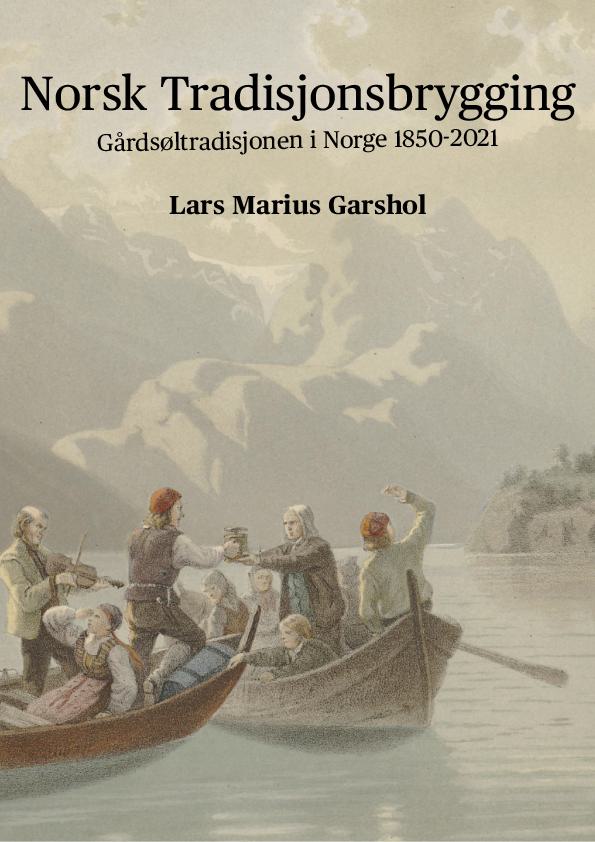
My home-made cover for the book. The publisher will make something better than this. |
I just sent to the publisher my academic book on Norwegian farmhouse ale, which summarizes what I've found in nine years of research on the subject. The text I sent is in Norwegian, but I may be able to get it translated into English. The English-language publisher wants to judge interest before they decide, hence this blog post. So if you're interested in that, read on to the end.
So what's in the book?
It's an in-depth analysis of Norwegian farmhouse brewing, using maps, charts, and lots of quotes from primary sources. It's my attempt to show what the brewing was like in all the various places in its full complexity, and to explain how it ended up being like that.
Chapter 1 mainly gets things going, but also has a section on the brewing in the far north of Norway. It looks at where the northern limit for brewing was, and also what brewing in that region was like.
Chapter 2 is a short history of beer in Norway, starting with the very beginning of brewing in Norway, taking it up to the present day. The focus is on how farmhouse brewing began and developed, and on how and when commercial brewing eventually branched off from it. There's also a good bit on the history of brewing cauldrons and when they were introduced, because this becomes important later.
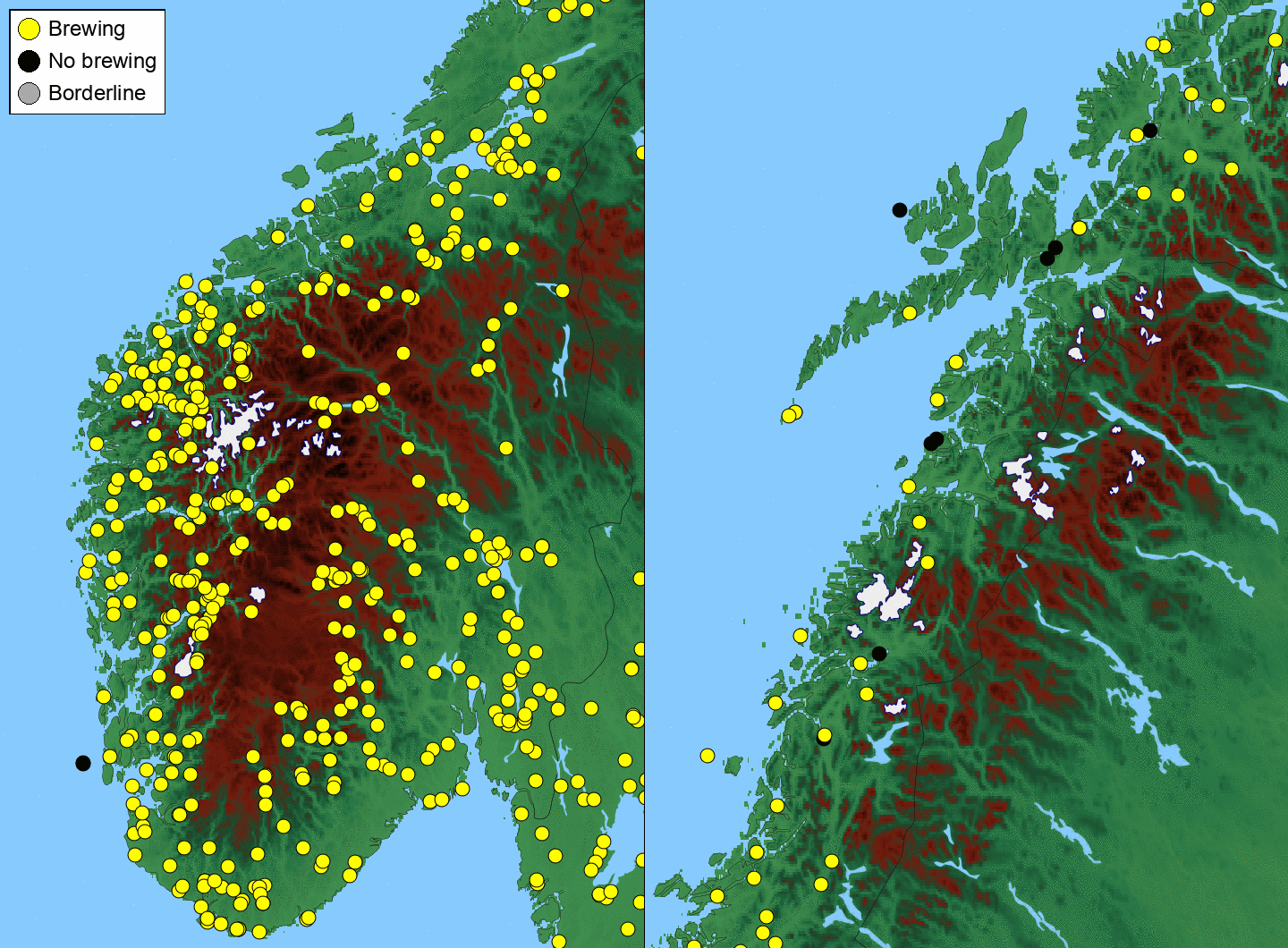
Map of where I can document that there was a tradition for brewing. I colour-coded in elevation so you can see why some parts have no dots. This map is not in the book, but one showing the Arctic north is, in order to support the discussion of the northern limit to brewing. |
Chapter 3 is a fairly brief outline of the equipment used, without much analysis. However, it does look at the two main types of lauter tun: with side tap (S-type) or hole in the bottom opened with a long rod sticking up (B-type), and finds that the map of who used what type where shows us how cultural influences spread out over the Norwegian landscape.
Chapter 4 goes into the cultural background and covers what occasions people brewed for, how much they brewed, how strong the beer was, and whether it was men or women brewing. It deeper into the issue of who brewed in the past than I've ever done before. Then we get to how people marked that the beer was finished fermenting, and it turns out oppskåke was only one of several customs. In fact, oppskåke only existed in parts of Norway, and the distribution of these customs isn't at all what you'd guess. Then we get into the names people used (and use) for the farmhouse ale, and beer flaws.
Chapter 5 is a deep dive into the brewing processes used in Norway, going through them step by step. First, acid rest prior to mashing, then all the bizarre ways of mashing, then wort boiling, then hop treatment, and a survey trying to put all of this together. We look at the likely reasons people had for using these methods, how they developed, and so on.
One thing that comes out clearly in this analysis is that western and eastern Norway had clearly distinct brewing processes. The distinction isn't 100% consistent, but close to it. The other parts of Norway mainly look like mixes of east and west.
Then a section on truly weird methods that need to be looked at specially, including the most in-depth review of Norwegian stone beer brewing ever. Finally, we go deeper into the kettle issue and how these processes likely evolved, and possible reasons we ended up with the geographic distribution we did.
One thing that comes out here is that the historical picture is far muddier than anyone has ever really reflected on. The timing of the introduction of the kettle is unknown, but from what we know about it the processes we ended up with are bit hard to explain. Then it also turns out that there's 4500 years of brewing where we can't explain how people brewed. If we make one not too unreasonable assumption we can reduce that to 3000 years, but there's still something very odd about what little we know.
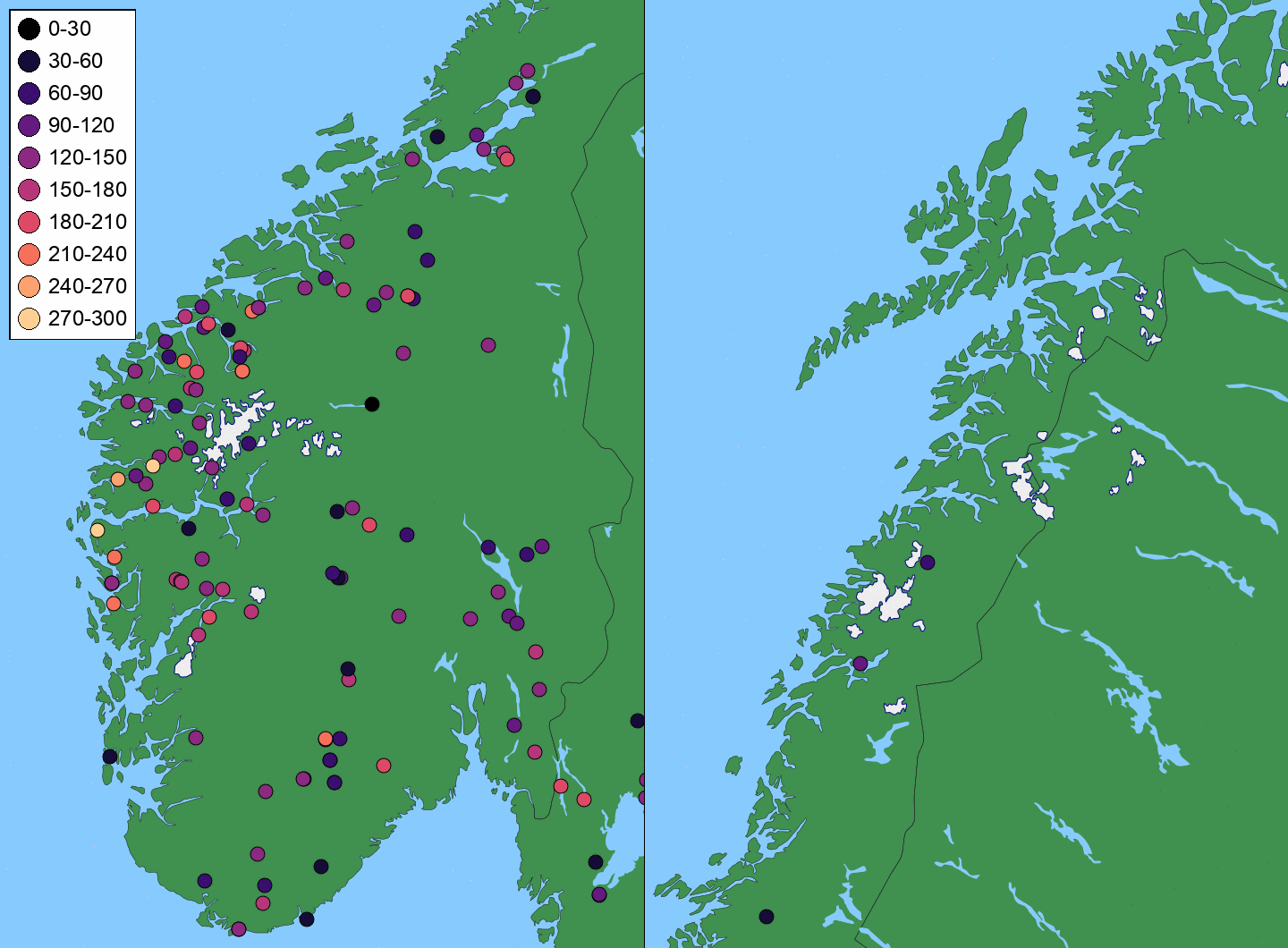
Map of what size of batches people brewed where in liters. This map is not in the book because I had to make room for more important maps and charts. |
Chapter 6 goes through what kinds of yeast were in use in Norway, such as bread yeast, farmhouse yeast, lager yeast, etc, and the history of their use and introduction. Then into the different types of farmhouse yeast in Norway, and what types might have existed historically. We also review what's known of the use of yeast in baking and how that relates to yeast in brewing.
All of this to set the stage so the reader can understand the next chapter.
Chapter 7 deep-dives into how people got hold of yeast, when they started buying yeast, and how people have been exchanging farmhouse yeast over the last few decades. Then deep into how people harvested the yeast, and the different methods for keeping the yeast. We get the first-ever surveys of what's known about yeast logs, yeast rings, and yeast cakes in Norway, plus a summary of how people do it today.
Then onto how and why people mixed yeast cultures, what contaminants we've found in these cultures, whether people did yeast starters and how, pitch temperatures, fermentation times, how people approached carbonation, and finally, an attempt to model mathematically what the actual fermentation temperatures were. This goes directly to the "how come a hot-tolerant yeast like kveik come from such a cold country as Norway?" question, and delivers a real answer.

Making a yeast starter from bread yeast at home. |
Chapter 8 deals with spice and we get the first real history of hop usage in Norway in about a century, an overview of how it was grown, and details on how it was used. Then the same for juniper, with data on its anti-bacterial effect. Then we run through the rest of the spice in a similar way, dealing also briefly with adjuncts.
Chapter 9 looks at other drinks, starting with small beer, and the many names for that. Then the soured mash drink, juniper berry beer, sugar beer (with some startling details), and birch sap beer. Then the first-ever survey of the making of kvass in Norway. A history of mead in Norway showing that we've only had about 250 years of mead-making here. And finally a survey of the history of cider in Norway.
Chapter 10 is a survey of where farmhouse ale is still brewed in Norway, and how it is brewed in the various areas where it's still alive, and what sort of history it's had in each place over the last century or so. The chapter is based on the 9 years of research data I've collected plus a marathon session of phone interviews I did this summer to extend the survey to areas we didn't know much about previously.

Steaming kettle in a brewhouse in Ulvik, Hardanger. Not used in the book. |
Chapter 11 tries to summarize all of this and break Norway into regions of (mostly) similar brewing, and analyzes why we ended up with those specific regions. It gets into how the geography of Norway shaped the brewing traditions and compares it with the distribution of Norwegian dialects. Plus, we look at how the historical developments led to all of this before we finally say goodbye to the reader.
For me, this is the culmination of a nine-year odyssey to try to really understand Norwegian farmhouse brewing in depth. I feel I can say confidently that nothing like this has ever been published before, and I'm quite proud to have taken the project all the way to this level. The closest equivalent to this book would be Odd Nordland's book, which was published in 1969, and mostly focuses on the equipment. (One reason why I've skipped lightly over that in this book.)
I say culmination rather than end, because I don't think it's going to end here, but I'm still hoping this will be the definitive work on the subject. Exactly how to go on from here I'm not sure, although doing similar surveys of Denmark and Sweden are definitely one possibility. If, that is, I can find publishers for those books.
Anyway, the potential publisher of the English translation needs to be convinced that enough people would interested in buying the book, because they're a bit worried it won't sell. If you're interested, please add a comment to that effect to help convince them that the book would find buyers. (The publisher suggested I do this.)
They are also considering whether to do a crowdfunding campaign to reduce the economic risk of publishing. If you have thoughts on that feel free to add them.
For those of you who read Norwegian: the book is expected to be out April 20th 2023, although where you can order it now already.
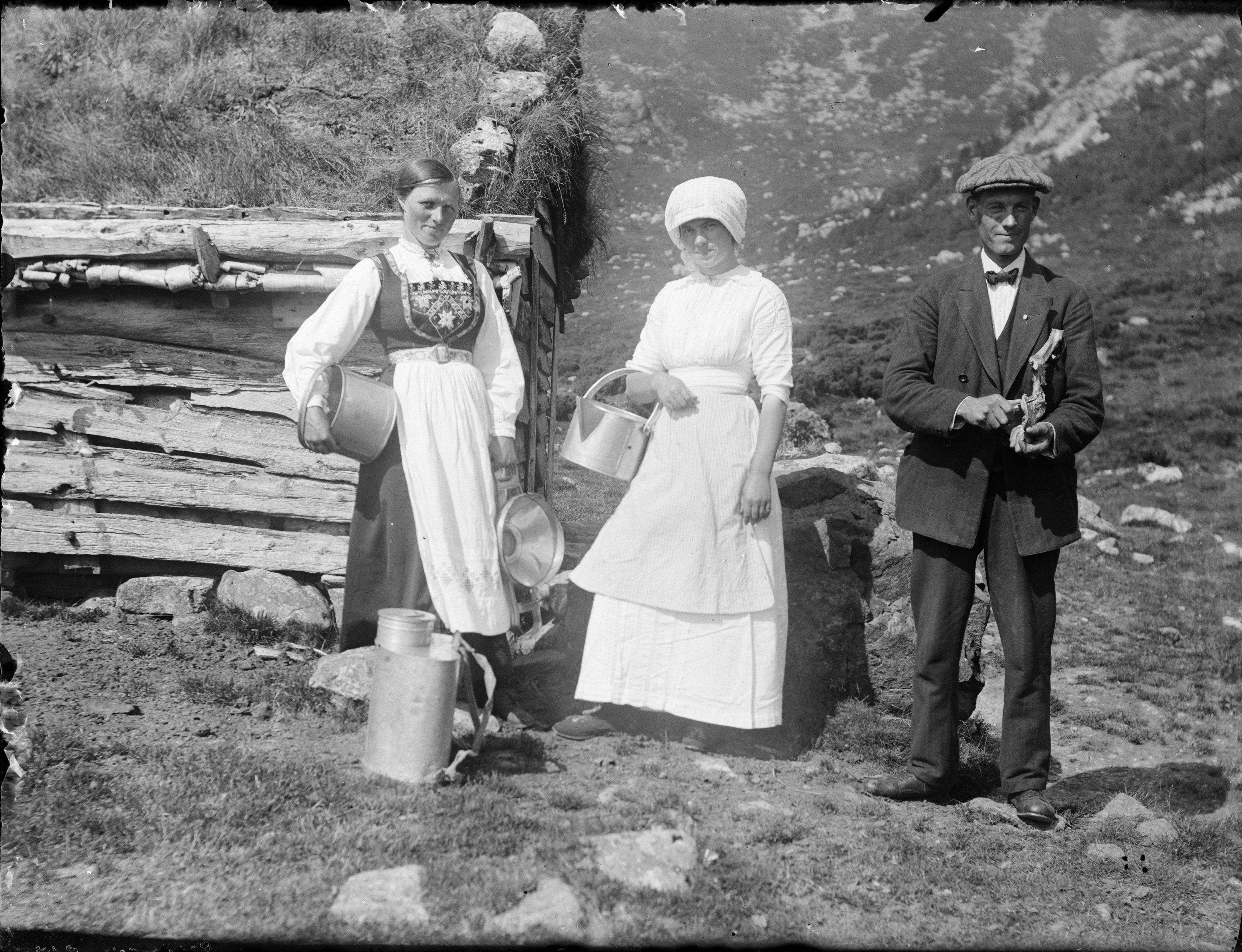
At the mountain farm (summer pasture) near Stongfjorden, Sunnfjord, roughly 1910. By Paul Stang. Public domain, from Fylkesarkiv Vestland. |
Similar posts
My book on Norwegian farmhouse ale
Yesterday I finally got a copy of my new book on Norwegian farmhouse ale
Read | 2016-09-17 12:03
A new book on Topic Maps
Those of you who have been waiting for a new Topic Maps book will be happy to hear that one has just been published
Read | 2007-01-01 20:15