What's in a Farmhouse Yeast?

A glass of kveik at Dale farm in Voss |
A new major paper on farmhouse yeast has just been published, which gives more insight into what's in a farmhouse yeast than we've ever had before. If you're not familiar with it, farmhouse yeast is yeast that has been reused by people brewing in the farmhouse tradition for so long that it's adapted to being used in that type of brewing.
The paper was done by the Verstrepen lab at the VIB-KU Leuven Center for Microbiology, the same place that did the famous paper giving us the first view of the family tree for brewer's yeast.
Work on the paper started in September 2017, when I mailed off the first batch of yeast cultures to Leuven. It had gotten quite far when covid caused Belgium to shut down so hard that everyone must work from home, and obviously you can't do lab work at home. By the time restrictions had lifted several people had moved on to other jobs, and the paper sat languishing until Peter Bircham decided to pick it up again. He and I worked on it for a while, until Peter moved to New Zealand. Eventually, once he was settled there, a Gang of Four got it moving once more, and last year we finally submitted it.
It's been a long road, and for me it's been extremely frustrating to know all these things about farmhouse yeast for almost a decade, without being able to share them. But now I finally can, and most definitely will.
The Yeast Cultures

A map of where the cultures came from. |
The map above shows where the different yeast cultures were collected from. The reason I'm calling them "cultures" and not "strains" is that these are not lab-purified yeasts broken into single strains. These yeast cultures have been reused by farmhouse brewers for at least centuries, quite possibly millennia, so they consist of lots of different strains.
In the paper they've been divided into seven groups by geography:
- North-West Norway
- This is the area northern kveik area, where they brew kornøl, the raw ale version of western Norwegian farmhouse ale. Effectively Nordfjord and Sunnmøre.
- South-West Norway
- This is southern kveik area, where they brew heimabrygg, the farmhouse ale with the long boil, which darkens the beer. This area covers Hardanger, Voss, and Sogn.
- Central-East Norway
- Effectively the municipality of Ål in Hallingdal in Eastern Norway, where they mash in the kettle. So far, very few yeasts from this area have been found, and I don't have permission to share them, so hardly any people have tried these.
- South-East Norway
- Again a small area, essentially the municipality of Tinn in Telemark, further south, containing the village of Atrå. The brewers here seem to all use malt extract. These yeasts have also not been shared.
- Lithuania
- In north Lithuania people brew kaimiškas (a fairly straight raw ale without juniper) and keptinis (oven-baked beer), and some of them have their own yeast. In fact, even commercial farmhouse breweries like Piniavos, Jovaru Alus, and Ramunas Čižas have their own yeasts. The yeasts for this study are from non-commercial brewers, collected by Simonas Gutautas of the Dundulis brewery.
- Latvia
- Latvia has active farmhouse brewing in both the east and the west. I toured the brewers in 2025, but haven't written about them yet. The two yeasts studied here come from farmhouse brewers in Latgale (the east), who make their own smoked malts. They were collected by Reinis Plavinš of the Labietis brewery.
- Russia
- Strictly speaking Chuvashia, a region along the Volga in central Russia, about 600km east of Moscow, peopled by the Chuvashians, a Turkic people. The brewers there are often oven brewers, and some have their own yeasts.
The Method

Figure S1, showing how the yeasts were processed. |
I sent them 44 farmhouse yeast cultures, from which they took 40 single-cell yeast samples out of each culture. No, we are not talking about strains yet. Hold your horses. The 40 samples were picked at random, so some samples contained the same strains, and others contained different strains. In total they had 1760 samples of yeast (you see what I mean about taking this to a new level), and the next step was to find out what was in them.
This was done by PCR fingerprinting. This is a method where a small section of DNA is taken out and read optically. It doesn't allow you to build a solid family tree showing the exact family relationships between the yeasts, but it does let you roughly sort out which strains are the same and which ones are different. It also gives you a sense of strains that are really similar to each other.
DNA sequencing, which you need for a solid family tree, is expensive, while PCR is cheap. And cheap is exactly what you need when you're working with 1760 samples. And in this case I would say we got a lot out of the PCR method.
How Many Strains?

A visualization of the result of PCR fingerprinting of Terje Raftevold's kveik. It's #5 in the Farmhouse Yeast Registry. Each sample is one column, and columns that have the same pattern of dark bands are the same strains. |
Across all the 44 cultures, the PCR analysis found 557 unique strains.
Now, we only looked at about two thirds of the known farmhouse yeast cultures, and still we found more yeast than what's in the entire Beer 1 and Beer 2 families of yeast put together. The 3034 yeast genomes paper has 350 modern strains of beer yeast all told. So it seems that there is a lot more farmhouse yeast in this world than there is modern yeast.
In fact, the imbalance is even greater than that, because in addition to the 40 randomly picked strains they also chose 6 strains that were picked based on visual appearance. For technical reasons those ended up being excluded from most of the analyses in the paper, but if we include those we have 649 unique strains.
As we'll come back to, even that probably understates the full number of strains quite substantially, even if we can't tell by how much.
Diversity

Map of where the Norwegian cultures came from. The numbers refer to the Farmhouse Yeast Registry. |
OK, so there is more farmhouse yeast than there is modern commercial yeast, but a simple count isn't really that interesting if they're all pretty much the same. However, 37 strains were picked from the 557 different ones, and whole genome sequenced. That made it possible to estimate the actual genetic diversity of farmhouse yeast, and compare it with that of other groups of yeast.
What the paper finds is that farmhouse yeast has "a vast genotypic and phenotypic diversity that far exceeds that of the industrial beer yeasts." The usual measure for this is nucleotide diversity, and farmhouse yeast had a diversity of 6.64. (All these figures should really be divided by 1000, but I'm skipping that for simplicity.) Comparable figures are 2.95 for Beer 2, 4.35 for the Mixed group, and 1.59 for Wine. Across the entire species of Saccharomyces cerevisiae it's 3.6.
If we look inside the farmhouse group we find that the northern kveik (kornøl) area has 4.12, compared to 3.13 for the British part of Beer 1.
In short, farmhouse yeast has more strains and much greater diversity than all modern beer yeast put together. You can think of it as the addition of farmhouse yeast expanding the universe of known brewing yeasts by perhaps a factor of five.
Most of the farmhouse subgroups have high diversity values (Lithuania 4.85, Latvia 5.03, etc), but the southern kveik area got a very low value: 1.06. It's possible that this is because nearly all the investigated kveiks seem to ultimately derive from Dyrvedalen in Voss. The only exception is the two from Hardanger ( #14 and #44, see map). After this paper was started we found found more kveik from Voss, and it's possible that including those would improve the numbers.
What About Contamination?
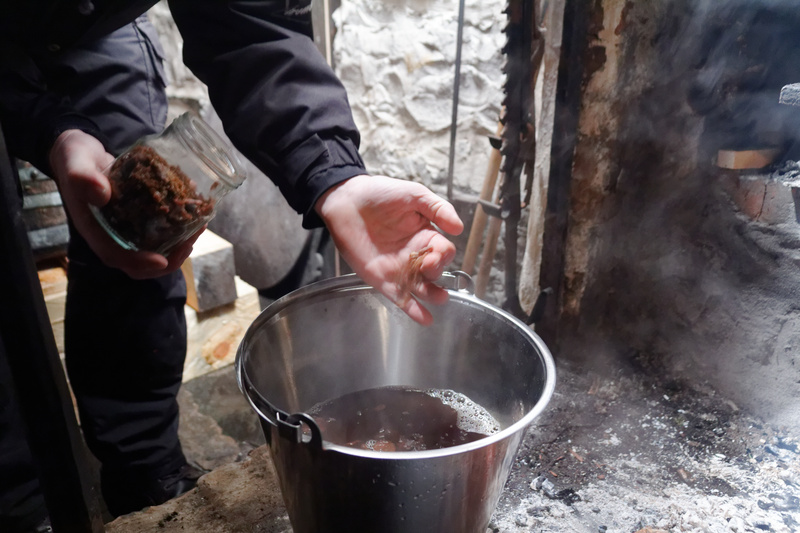
Jarand Eitrheim, dropping #14 into wort to make a yeast starter. |
One issue that's been speculated on at length is to what extent these farmhouse yeast cultures have been contaminated. After all, they have been reused through generations beyond count without any form of lab equipment. This study didn't look at bacteria, so it can't say anything about that, but with 1760 random samples of yeast we get a very good look at what kinds of wild yeast might have made it in.
On the species level this is super simple to summarize. They found 1738 strains of Saccharomyces cerevisiae, the same species as beer yeast, and 22 strains (1.25%) of Pichia membranifaciens. That's it. No Brettanomyces at all. (We'll see later that there is evidence for one more yeast species having been in these cultures.) One thing this shows very clearly is how incredibly dominant Saccharomyces cerevisiae is in fermentations. Other yeasts must have dropped into these fermentations from time to time, but they lose out in the competition and fade out of the cultures.
Of course, the full story is a little more complicated, because Saccharomyces cerevisiae includes both farmhouse yeast, modern beer yast, wild yeast, and more. So some of the 1738 samples could be wild yeast. However, of the 37 that were sequenced, exactly zero were wild yeast. These 37 were chosen because their PCR fingerprints made them look different from each other, so this is strong evidence that wild yeast is at least rare in these cultures. Again the reason is probably that wild yeast is not adapted to fermenting beer wort, and so even if they do get in, they lose out in the competition.
However, ...
There's More Than One Kind of Contamination
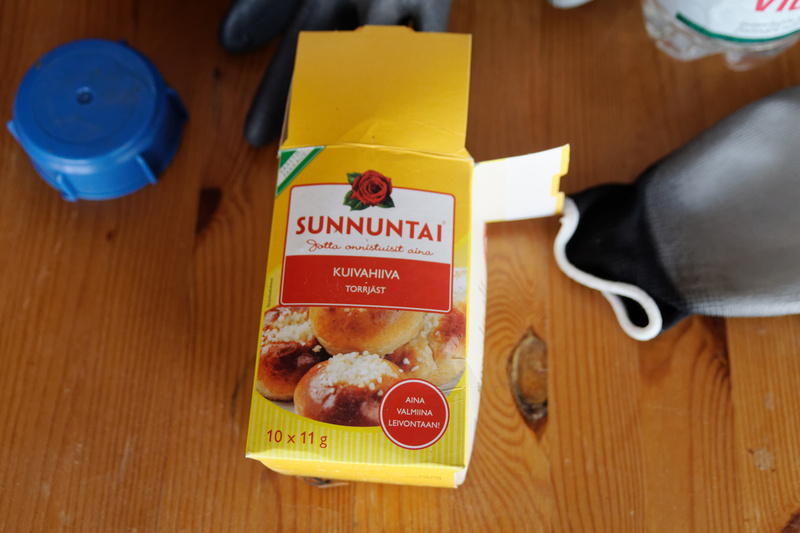
A packet of dried Finnish baking yeast, in the brewhouse of a Finnish sahti brewer in Hartola. |
The whole genome sequencing found that some of the 37 yeasts belonged to the Beer 2 and Mixed groups. (We'll come back to that analysis later.) In fact, one of them turned out to be the same yeast as #4 Muri, so that one, at least, has to be a commercial yeast that must have made it into the farmhouse yeast culture somehow.
The VIB lab has a big library of yeasts that they already have PCR fingerprints for, so they went back and looked at whether any of the 557 strains were in that library. With that they were able to identify in total 86 out of 1738 yeast strains as being commercial yeasts. The paper calls these 'allochthonous' strains, meaning basically, 'coming from outside.' In many of the analyses these are excluded, to make sure that we're not mixing noise into what's meant to be analyses of farmhouse yeast.
The reason we don't call the outside strains contaminants is that we don't know how they got there. For all we know someone may have mixed them in deliberately. So to avoid making a judgment we chose this term.
What's interesting is where these were found. Two cultures with outside yeast had been taken over by modern homebrewers and reused by them, before we got hold of them. In my opinion, the modern homebrewers introduced these strains by accident, and the chance of this happening was increased by them using the farmhouse cultures in ways closer to modern brewing. One culture was revived by a farmhouse brewer who had switched to modern brewing, and a culture being revived is always at much greater risk of being contaminated.
And, finally, one Russiand and one Latvian culture had outside yeast, probably because people in the area have been using wine yeast, bread yeast, or something similar. Maybe in winemaking or baking, or maybe they've been using it in farmhouse brewing deliberately. People in these areas do exchange yeast, but I don't know enough to say how the strains got in there.
If you want more detail on this, I go through the histories of these cultures and the known circumstances in section 6 of a supplementary note to the paper.
The big picture takeaway from this, however, is that contaminants in farmhouse yeast cultures clearly are rare. And that goes for both wild yeast and commercial yeast. The reason wild yeast appears so rarely is almost certainly that the competition is too hard for them. They can't reproduce and ferment at the same rates as the farmhouse yeast, and thus even if they get in their proportion of the culture quickly dwindles to nothing.
Commercial yeast clearly does have some ability to compete, but it's striking that none of the outside yeast belonged to the most common family of beer yeast, the Beer 1 family. That's probably because those yeasts are over-adapted to modern beer brewing, and find it difficult to handle anything else. They probably couldn't keep up in competition with the farmhouse yeast when fermentation temperatures were a little higher than usual, the beer was strong, and they had to survive in between batches.
Very likely that's hard also for Beer 2 and Mixed yeasts when the brewer is reusing the yeast under full farmhouse conditions. That's probably one reason why we see so few cases of contamination. Another is probably that most of the brewers from whom these cultures come have stuck to only using their own yeast, thus avoiding the issue entirely.
But, Wait, There's More ...
This is already a pretty long blog post, so I think it's best to stop here, but so far we've only just scratched the surface of what's actually in this paper.
Similar posts
Kveik analysis report
One of my goals for the Norwegian farmhouse ale trip was to see if kveik (family yeast) still existed in Norway, and to get samples if possible
Read | 2014-09-26 08:11
Farmhouse yeast: what do we know?
There's a lot of excitement over kveik at the moment, but kveik is only one kind of farmhouse yeast
Read | 2021-02-06 20:33
A family tree for kveik
In 2016 I was contacted by Canadian researcher Richard Preiss
Read | 2017-10-06 10:02
Comments
No comments.