Innis & Gunn tasting
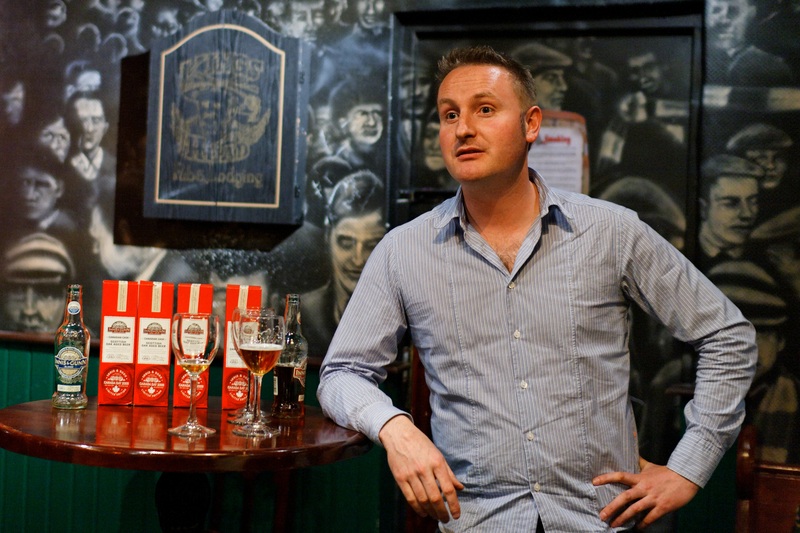
Dougal Sharp speaking |
Innis & Gunn has met with a divided reception among beer enthusiasts. Some really like it, some think it's not bad, and some hate it. Personally, I quite like it, and it's one of the very few beers that are oak-aged and fairly widely distributed. So when Dr. Jekyll's pub in Oslo announced a tasting with Dougal Sharp, the creator of Innis & Gunn, I signed up.
Working out which brewery is behind the beer is a bit tricky. The bottles describe the producer of the beer as as "Innis & Gunn Brewing Company," but there no such physical brewery. Instead, Belhaven, a Scottish brewery, brews the beer under contract. So that kind of makes Innis & Gunn a contract brewer (or "phantom brewer", as the Danes would call it), but one that only contracts a single brewery, at least at the moment.
The Innis & Gunn process is described as "unique", which may sound odd (and like a tired cliché), given that oak-aged beers are not that unusual any more. However, the process they use is actually different from what's usual. They buy oak casks that have been used to age bourbon in the US, ship them in pieces to Scotland, and reassemble them there. This means that the barrels are actually dry when they are used to age Innis & Gunn, and that none of the alcohol in the beer comes from the whisky. As far as I know they are the only ones to use this exact procedure.
Dougal said that each cask produces a quite different beer, which is similar to what other brewers have been saying about oak-aged beers. In fact, quite a few casks would produce vinegary sour stuff, which they would throw away. To get a somewhat consistent result they then blend the beer from the different casks after the aging. They also dilute the aged beer a bit, which they claim releases more flavour, in much the same way that adding water to whisky is said to do.
Dougal described the base beer (that is, the beer that goes into the casks) as "quite bland". The idea is that they want most of the flavour to come from the casks themselves, and only some from the beer. This is also different from the usual approach with oak-aged beer, where the aging is used more to wear off the edges of a sharp and powerful base beer than to really impart a major flavour to the beer. Mikkeller's Calvados beer is about the only exception to that I can recall.
I quite like the Innis & Gunn Original (at 6.6%), even though it's pretty mild, and tastes primarily of perfumy vanilla, which feels a bit artificial, partly because it's so prominent and distinct. This is the bit that many people hate, some claiming that it must come from vanilla essence. Whisky enthusiasts, on the other hand, claim it's perfectly reasonable for a bourbon barrel to produce this taste, and Dougal denied there was any artificial flavouring in the beer. There's not just vanilla in the aroma, though, but also quite a bit of nuts, caramelly malts, and smoky hints. I rated this at 3.8 out of 5.0, but that's an old rating, and probably too high. Today I estimate I'd give it 3.2 or thereabouts.
Since the base beer is so bland, it means that with different casks one could get quite different beers, and this is what Innis & Gunn have started doing. So at the tasting we were offered four different beers, starting with the new Innis & Gunn Blonde. This was paler than the Original and slightly lower in alcohol at 6%. It's milder than the Original and quite subdued. Still a bit of perfumy vanilla, but also floral hops and paper. In general I thought this one had too little flavour, and gave it 3.1 out of 5.0.
We then moved on to the Original, which I've already described, and after that to Innis & Gunn Canadian Cask (7.1%). For this they used Canadian whisky barrels, and it's interesting how different from the previous two beers it was. The vanilla and the artificial feel were just about gone, and now earthy floral chocolate predominates, with roasty dusty fruity notes. It was very harmonic and easy to drink, and I liked this one more than the previous two, rating it at 3.3 out of 5.0.
The best they saved for last: Innis & Gunn Rum Cask (7.4%). This one had some vanilla in the aroma, but the taste was actually slightly acidic and vinegary from the casks. The acid was quite mild, though, and the sweetness was still there, in an unusual combination I quite liked. The basic taste was floral metallic and earthy. This one I gave 3.5 out of 5.0, making it the clear winner of the four.
Dougal said that not only did each barrel produce a different beer, and some of them were much better than the others, and they were kind of sad about having to blend these in with the rest. In the future they were thinking of doing some special single-barrel bottlings of Innis & Gunn, so that people could try these beers separately from the main bottling. I found that to be an intriguing idea, and would quite like to try it, especially if I could compare two different casks to each other.
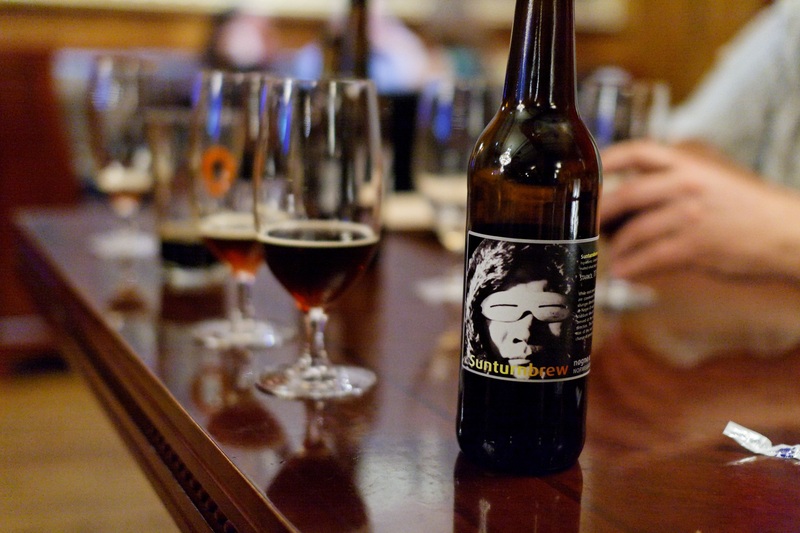
At Olympen |
Overall, it was definitely worth attending the tasting, and hearing the story behind the beer (which you can get on their web site) directly from the source of course added to the interest. I should have had a picture of the Innis & Gunn beers, but stupidly did not do it before the tasting started, and once it got under way I was much too busy taking notes to even think about it. After the tasting we headed over to Olympen for more beer, so the final photo is from there instead.
Similar posts
BrewDog Paradox whisky beers
I don't usually do beer reviews on this blog, but I got "reviewer copies" of the BrewDog Paradox Smokehead and Isle of Arran, and thought they were worth writing about
Read | 2009-02-15 13:35
Ringnes Imperial Polaris
For years now everyone's been wondering when Ringnes was going to wake up and realize that the old days of selling cheap industrial beers were over
Read | 2012-10-04 20:25
Samuel Adams Utopias
Samuel Adams Utopias is the world's most expensive beer in regular production, costing about USD 100 in the US
Read | 2008-11-15 21:40