Riga on the rise
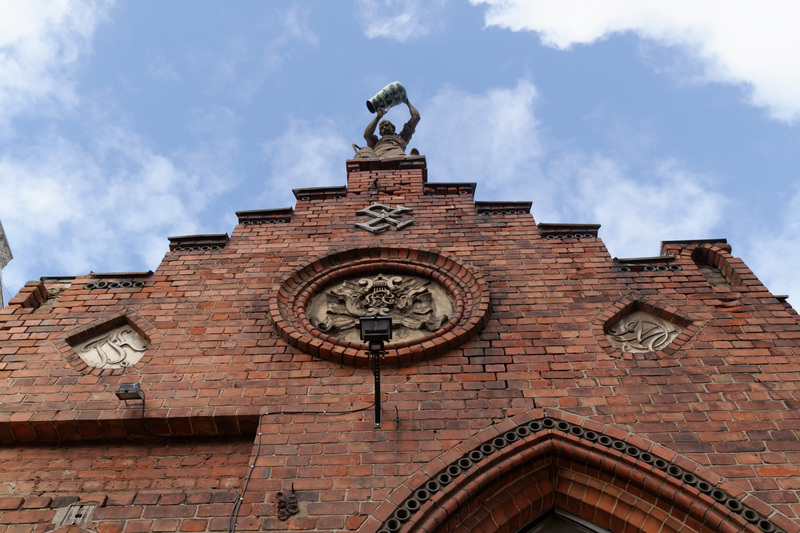
Old building, Riga |
Since I'd learned that there was farmhouse ale in Latvia still I went back to Riga hoping to learn a little more. Studying the Ratebeer ratings from Latvia I'd seen that fellow ratebeerians had identified some of the smaller new breweries in Latvia as potentially farmhouse breweries. I was hoping to try their beers and learn a little more.
I'm leaving out everything I found on my previous visit. So all of the places listed here, and in fact all of the breweries, have opened in the last two years. Hence the title.
Peter's Brewhouse
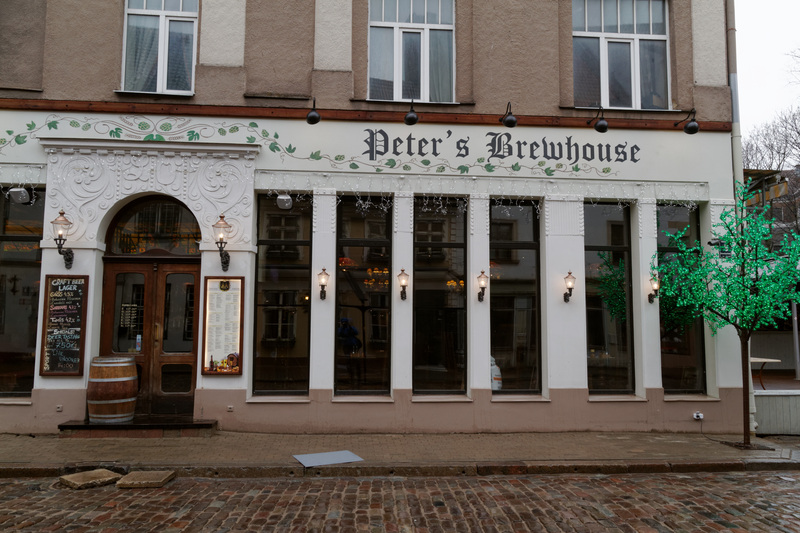
Peter's Brewhouse |
The first place I stumbled across while still in the old town was a new brewpub called Peter's Brewhouse. Entering, I'm met by two waitresses, one of whom suggests I take a seat by the window, next to a loud, raucous group of Americans. I thank her, pretending to agree, but when she turns her back I pick a quieter seat at the back, and out of the corner of my eye I see the other waitress smiling.
It's a modern, upscale place with a theme that suggests the historic without attempting any sort of illusion of accuracy. The menu is straightforward: a blond, a dark, and a red lager. The dark and the red lager were not very good, and I actually liked the blond best, without thinking much of it. In the menu the red lager was described as hopped with Cascade and Columbus, "that give beer amazing aroma." In my tasting notes that turns into "faint fruity perfumy aroma." The menu goes on to add that "Those hops are used in the best German and Czech breweries."
And thus we're full circle, in a way. Cascade, a hop growers couldn't sell to lager brewers in the 1960s and 70s, is now not just used in lager but even touted as a traditional lager hop. It's really this brewpub in a nutshell: designed to cash in on the new beer trend without in any way taking it seriously. The menu illustrates that attitude: just slap together some text that hints at excellence by playing on well-known stereotypes, and off we go. That anyone with the most basic knowledge of the beer scene knows it to be false is no obstacle.
Labietis
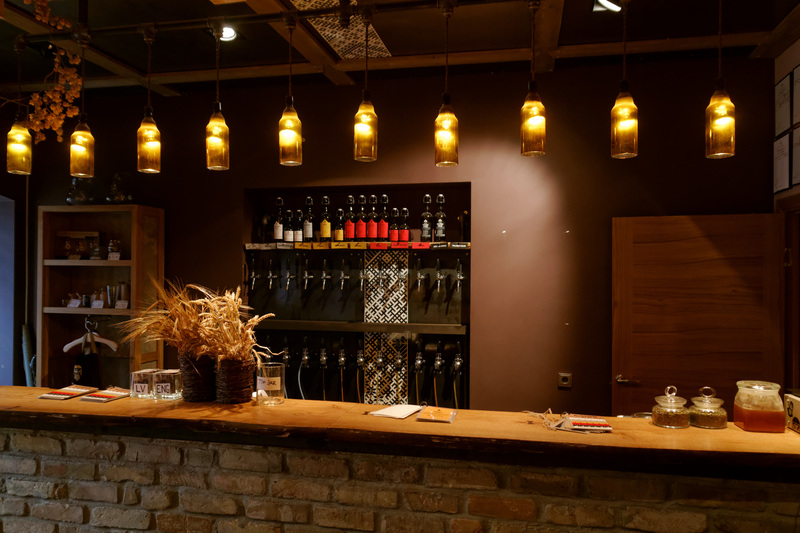
The bar at Labietis |
The attitude is rather different at Labietis, another new brewpub, but this one a good 2-3 kilometers from the old town. It's a stylish, modern pub, with a few small tables and chairs along the wall on both sides of the room, and a single giant wooden table dominating the middle. They serve no food, other than a plate of local cheese, so the emphasis is very much on the beer.
Labietis is a modern craft brewery, but not in the naive "let's brew some IPAs and porters" type of way. Instead, they've been very creative, drawing on past traditions without necessarily attempting (or pretending to attempt) any kind of historical veracity. Their Radzinš (4.3%, 11 IBU) is a wheat beer flavoured with carraway (as in some Norwegian farmhouse ales), and quite a lot of carraway by the flavour. The result is reminiscent of a Belgian wit, but more herbal and grape-like.
I didn't get to try their Tapinš (2.5%, 20 IBU), which is something so rare as a small beer (that is, a beer from the second runnings out of the mashtun). Historically, that was an extremely important beer style all over Europe, but now it's mostly gone. I can't recall ever tasting it. The Mežs (5.6%, 7 IBU) used juniper berries, which gave a noticeable juniper flavour, although less prominent than in Norwegian ales with juniper branches.
Akmenrags (4.5%, 13 IBU) used heather and wild thyme, giving a flavour that to me was reminiscent of fruity floral juniper with spicy notes and traces of perfume. My favourite was Plava (6.3%, 11 IBU), a soapy, floral lavender-tasting beer that was soft, flat and smooth in the mouth, with a sweetish floral coriander-like aftertaste. It was actually dry-hopped with yarrow (another familiar ingredient) and meadowsweet (formerly much used in mead).
Overall a very nice pub, with good music, excellent service, and staff who knew about the beer, spoke English, and could give meaningful advice. They even had a tiny booklet explaining all the beers with ingredients, plus figures like alcohol, IBU, colour, and final gravity.
Vest
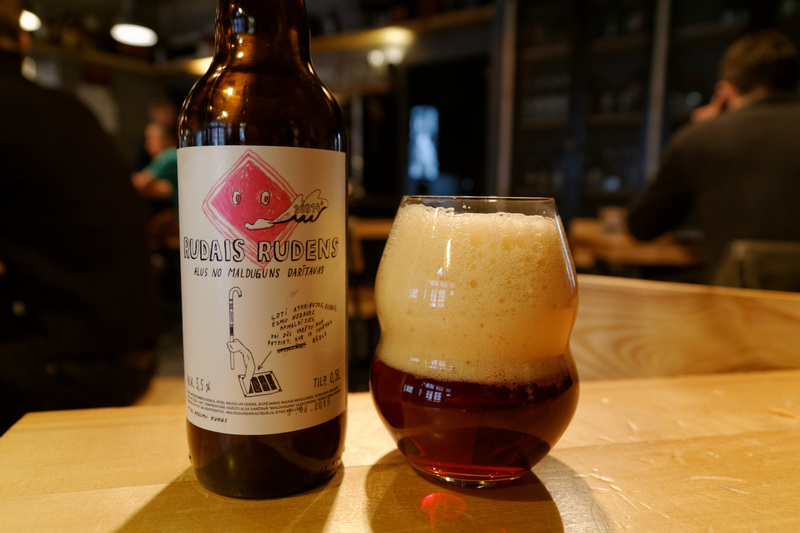
Malduguns beer at Vest |
A bit closer to the old town is Vest, a bar that could have been created specifically to showcase the close connections between craft beer and hipsterism. Bearded, tattooed young things with chains and strange clothes stand behind the bar, and sit drinking and talking. A highly polished motorbike stands in one corner. Next to it is a retro-style barbershop where two people are getting elaborate haircuts.
Anyway, the music is good, the food is good, the service is impeccable, and nobody seems to mind that a person with zero hipster credentials (me) is having a beer. The selection mostly consists of beers from Malduguns, a new Latvian modern craft brewery. Again a brewery that has the good sense to do more than simply brew straight takes on well-known styles. Their Pilota Nakts is a funky, earthy, slightly vinegary stout. The Rudais Rudens is a very slightly acidic roasty earthy brown ale with wooden green apple notes. Several more of their beers were in this vein, an all highly drinkable and interesting. Overall, I think Malduguns is a brewery to watch.
TAKA bar
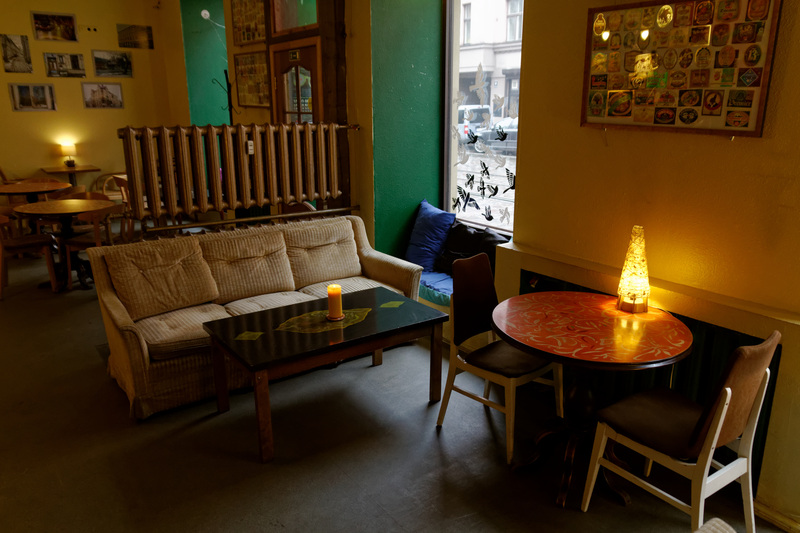
At TAKA |
I asked around in bars and bottle shops to see if anyone knew about Latvian farmhouse ale, but everywhere the answer was no. A couple of people suggested I talk to the owner of TAKA bar, so I tried that. The bar itself has a nicely retro style with lots of space, quiet music, and seems in some ways as much a coffee bar as a beer bar, but the beer selection was really good.
I tried BURSH alus, one of the beers flagged as a possible farmhouse ale. It was certainly unusual. Low carbonation, slightly acidic, strange herbal, spicy, floral taste with apple and metal notes. The acidity was so light and clean that it added to the beer rather than disturbing. I couldn't really place this beer, and wondered how it was made.
Later, when I spoke to Juris who owns the bar I learned that BURSH ferments in open, wooden fermenters, which might well account for the unusual flavour. However, they use lager yeast, and there is no tradition for this in Latvia, so it's not a farmhouse ale. The other new breweries that seemed like they might be farmhouse turned out to be similar.
However, Juris also told me that farmhouse brewing is still alive in the province of Latgale, in the east, up against the Russian border. In fact, his own father used to brew raw ale, mashed with hot stones in wooden tubs. As far as I can tell, the beer style has no name. Juris says the brewers call it simply "alus". His father used to make his own malts, removing the shoots and rootlets by hand, exactly like Harald Storli. If I understood him correctly, farmhouse brewers elsewhere in Latvia boil their beer.
Going home
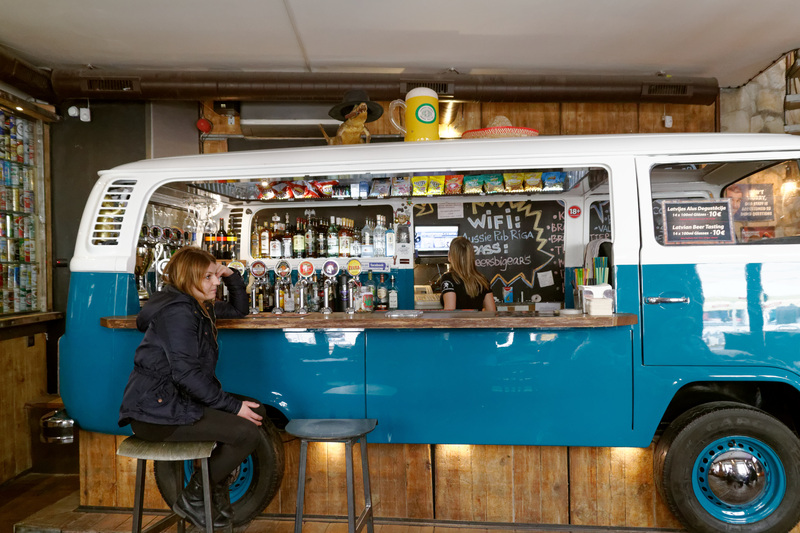
Aussie Backpackers Pub, Riga |
Martynas had told me that an excellent book about Latvian farmhouse ale existed, but I didn't know the title or the author. So I tried asking around about this, too, in shops, bars, and even in bookstores, but got nowhere. Then, on the day I flew home, I find that Simonas Gutautas added a comment on the blog with a link to the book. So there it is. Now I just need to get hold of a copy somehow.
Anyway, the change in the Latvian beer scene over the past couple of years is striking. Latvian brewing is making great strides, and there is now quite a bit of interesting beer worth exploring. In this blog post I passed over several new breweries, bars, and shops, so there's actually even more going on. You may not be able to buy farmhouse ale (unlike in Vilnius), but certainly there is beer worth drinking. And who knows what the Latvian beer scene will look like in a couple of years at this pace.
Similar posts
Impressions of the Riga beer scene
When I landed in Riga, I have to admit I was more curious about the state of Latvian beer than about the city itself
Read | 2013-10-07 19:00
Japanese beer
Japan is not, of course, a country with any great beer tradition to speak of, and so one may be forgiven for thinking that it's all a dreary swamp of bland pale industrial lager
Read | 2007-06-04 20:52
The sameness of craft beer
I can remember when and where I became seriously interested in beer
Read | 2014-11-25 18:11