Imperium
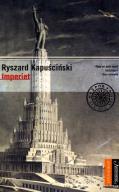
Imperium (Norwegian edition) |
Ryszard Kapuscinski is very well known to what appears to be a rather small group of people. I read this book in 2006, and it was my introduction to him. I liked it enough that I'm going to read the rest of the books he's written, although they are unfortunately not that many. (I wrote this while in the middle of "The Soccer War".)
The book is not easy to classify, but I suppose calling it a mix of a memoir and a travel book with an essayistic dash thrown in wouldn't be entirely inaccurate. The empire of the title is Russia, and the Soviet Union. Part of the book's thesis is that while the two are different, they could equally well be thought of as a single empire going through different life phases. It's divided into three pretty straightforward parts. The first part describes in autobiographical fashion how Kapuscinski, at the age of 12, experienced the Soviet occupation of Pinsk (then in Poland, now in Belorussia, but for a considerable time in between in the Soviet Union).
The second and third parts consist of some chapters that describe travels through the Soviet Union, while others cover interesting stories of various sorts. One of them is the story of the cathedral-turned-swimming pool that I described in the blog posting about Moscow. Another is about an insane project to tackle the artificially created environmental disaster of the Aral Sea, which is still going on (the disaster, not the project). There are also a couple on the separatist republics of the Caucasus and central Asia.
One of the main strengths of the book is Kapuscinski's excellent writing, which is of almost literary quality rather than normal journalistic fare. Another is his almost uncanny ability to focus sharply on some minor event and make it mirror so much of Soviet society as a whole that his little chapters start feeling almost like prize-winning short stories. He's been mentioned as a Nobel prize candidate quite often recently, and not without reason. Sadly, he died a couple of weeks ago, at the age of 74.
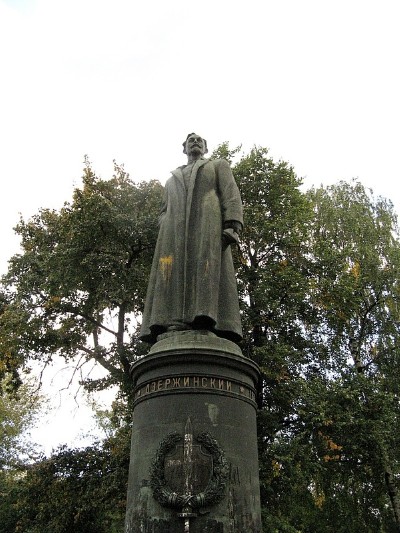
Felix Dzerzhinsky, founder of the Soviet Union's secret police |
An example of this detail-reflecting-the-whole is an account of a train journey on the Trans-Siberian Railway, which in 15 pages brings home the grip Stalin's terror held the Soviet Union in well enough to rival Radzhinsky's much longer biography. It is also a meditation on the awesome vastness of the Soviet Union, which made up one sixth of the planet's inhabited land. Some of the travel accounts are interesting also because of the places Kapuscinski decides to visit. He visits Vorkuta, and describes a labour conflict (post-1989!) in a society where leadership outside the communist party has been almost eradicated.
He also visits Magadan, the capital of the other major GULAG camp network (Kolyma), which must be a very strong contender for the claim to being the most remote city on earth. The nearest city is Yakutsk, which is 2000 kilometers away by a single unpaved road, and, well, Yakutsk is itself a strong contender in the same category, but not nearly as remote as Magadan. Kapuscinski's description of the trip is typical of his writing, and he manages to cram substantial reflections on air travel in Siberia, human cruelty, Stalinism, the GULAG system, and life at the end of the world in the 1990s. All of it a mix of literary quotations, accounts of his own observations, and philosophical musings. And all of it compulsively readable.
In summary: this is a great book. Even if you are not interested in Russia you want to read it. If you want to know a bit more about Kapuscinski I recommend this interview, or this excellent article from the New Yorker.
Similar posts
Why Nations Fail — a review
Kapuscinski once wrote of a road trip to Onitsha, a market town in Nigeria famous for the special brand of literature sold in the market there
Read | 2014-04-05 13:38
From Krakow to Lviv
We really wanted to visit Lviv during our 2006 holiday in Ukraine (photos), because of the praise heaped on it in the guidebook, and in travel reports in various newspapers
Read | 2007-09-19 20:35