Studying Farmhouse Yeast Genomes
This is the third blog post on the new Verstrepen lab paper on farmhouse yeast. While we were working on it we thought the family tree showing that kveik, gong (Eastern Norwegian farmhouse yeast), and Baltic farmhouse yeast were all one big family was going to be the headline result. As it turned out, the paper by Richard Preiss et al, came first. Still, it's nice to see that these two papers agree.
A recent paper by Norwegian researchers also finds the same thing (see figure 2, but be warned that it's very hard to read), so that farmhouse yeast is a separate yeast family is now pretty comprehensively established.
The family tree
The family tree from this paper has some interesting things in it, though, so let's have a look at it anyway. The strain codes, by the way, are straightforward: the first number is the number of the farmhouse yeast culture the strain came from, taken from the registry, and the second number is just the sequence number of the sample.
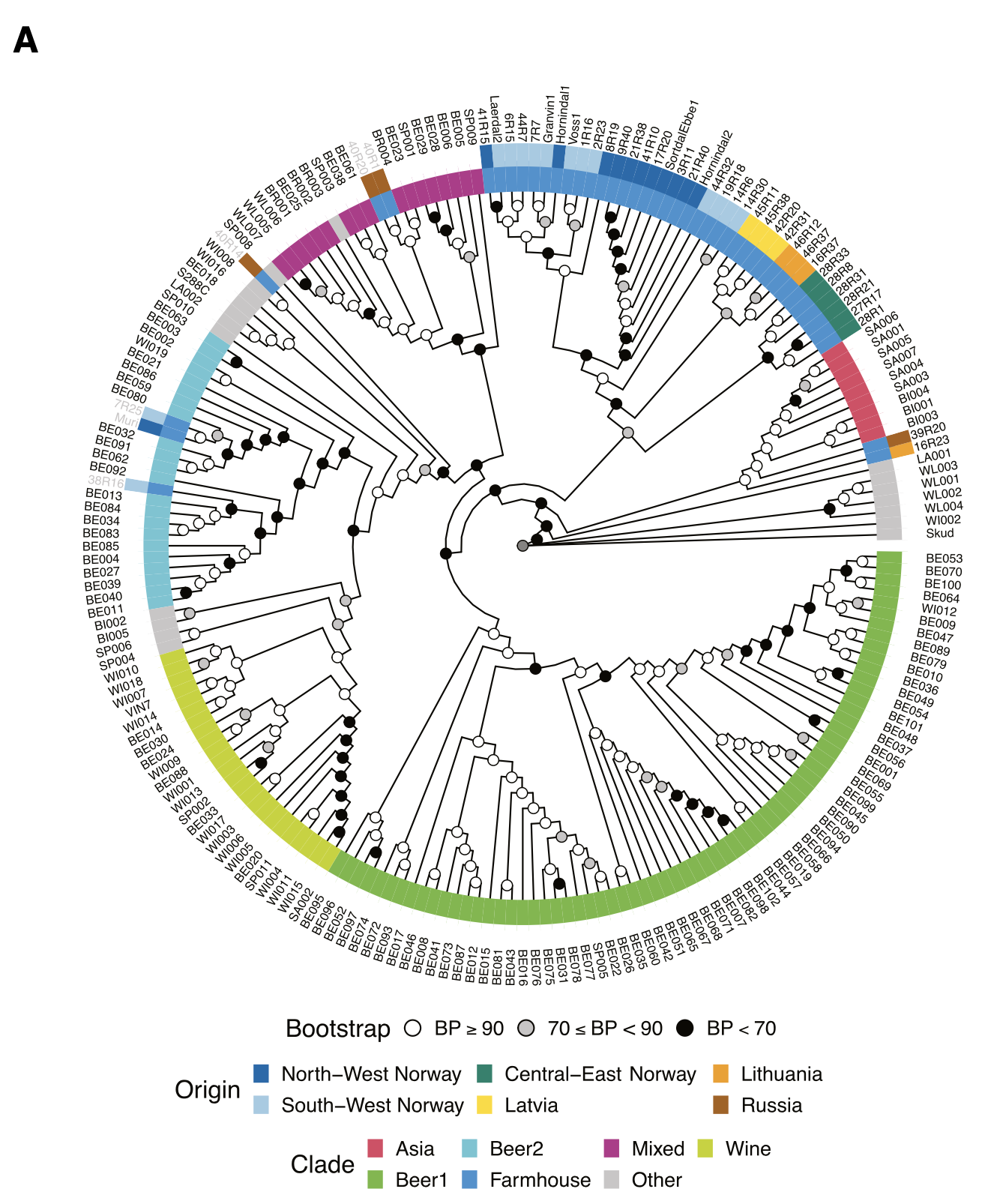
Figure 3A from the paper, showing the family tree based on whole genome sequencing. |
The farmhouse yeast family is at the top, with kveik in pale and dark blue, all one nice, tidy subfamily. Then, in orange and yellow, is Latvia and Lithuania, respectively, and not only are the Baltic strains a separate subfamily, but the strains even group by country. Finally, in green we have gong, from Eastern Norway, also a nice, tidy subfamily. This is all familiar stuff from the Preiss paper.
If you look at the top left you'll see some grayed out strains. These are the outside yeast (contaminants, if you will) that were found by sequencing. But there is a surprise on the far right. One Russian and one Baltic strain, sitting next to the Asian clade. The Asians are yeast from indigenous Asians beers, like sake and huangjiu.
So what are these? There are basically two possibilities. One researcher who has built a giant yeast family tree told me that some bread yeasts end up in roughly this position. So this could be outside yeast that's sneaked in. Or it could be that these are real farmhouse yeasts, but from a different family. European Farmhouse 2, essentially.
As you see, the family tree above includes strains sequenced for the first Preiss paper in 2018 (these are the strains with names instead of codes), but the second Preiss paper came out while we were working on this paper, so the reviewers made us include the new yeasts from that paper as well. That tree is in figure S3A (in supplemental materials), and there 16R23 has migrated from the Asian section into the farmhouse clade (Lithuanian sub-sub-family). So that one, at least, probably isn't an outside yeast. But maybe it belongs in the existing farmhouse family — we don't really know yet.
However, there is another interesting tidbit in the paper.
Population structure
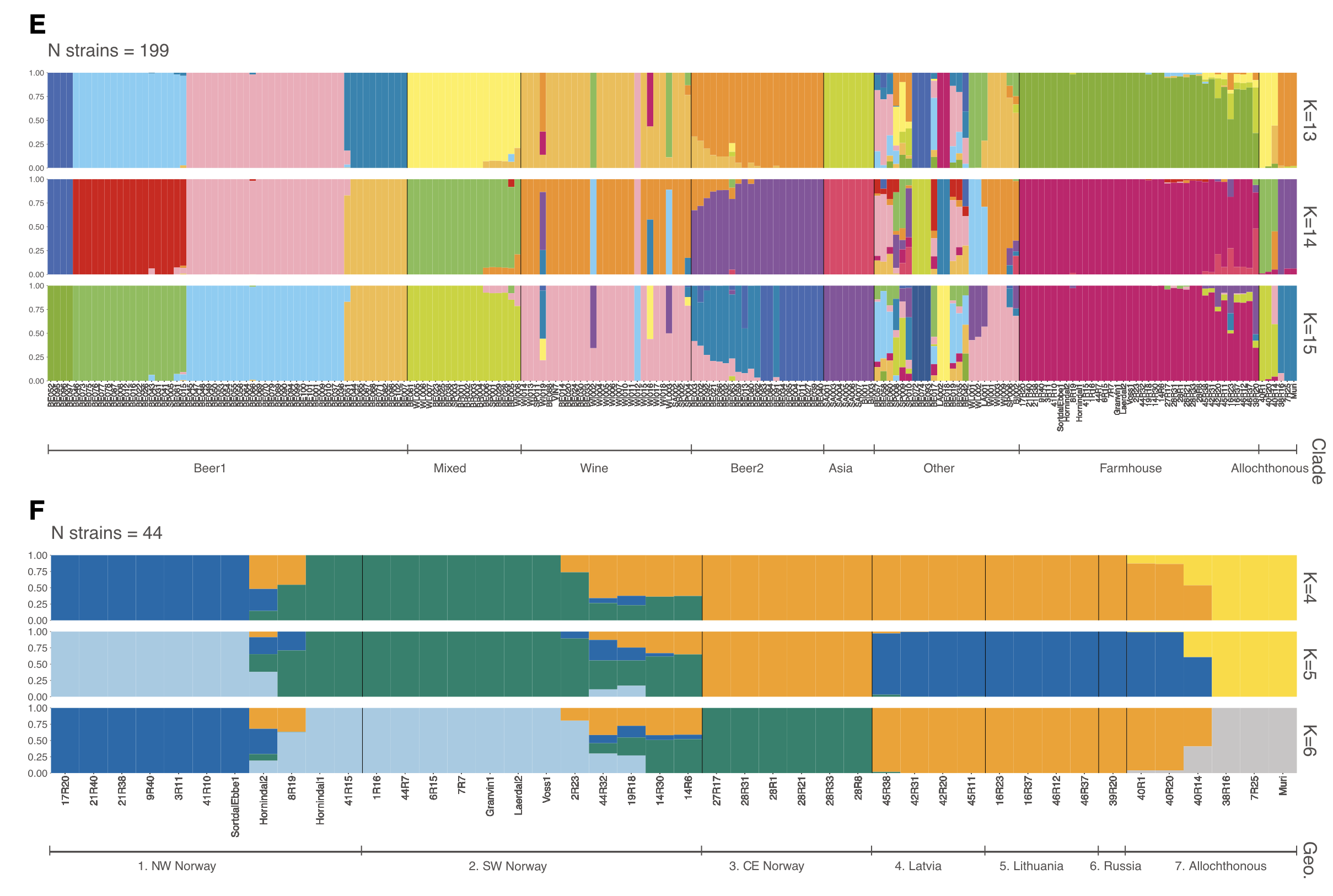
Figures 3E and 3F from the paper. |
This figure is a bit tricky to read, but each vertical bar is a yeast strain, and you see the codes and families underneath. Let's focus on 3E, the upper part, for now. You can think of this as an algorithm that's grouped individual genes into K different groups, and in this case 15 groups is the one to focus on. The farmhouse strains are on the right, and as you can see their genes have nearly all been placed into the magenta group.
However, on the right you can see some genes have been put into other groups. See the purple there? If you look toward the middle, you'll see the Asian strains all have that purple colour. So this is indicating that some of the genes in the farmhouse yeasts have Asian origin. There's also a little bit of genes from the Beer 1 family. (Both of these are results the Preiss paper found as well.)
Two strains stand out as having more Asian genes than the others, and those are 16R23 and 39R20, the two that were grouped close to the Asian strains in the tree. So clearly there is something about those two strains, but to find out what it is we'll need more Baltic and Russian strains to see if we can find more strains that are similar to them.
A different result on these two two yeast strains is that they are not phenolic (more about this below), because two specific genes have been destroyed by nonsense mutations. What's interesting is that the yeasts in the farmhouse family have the exact same nonsense mutations as these two. That suggests these two strains really are related to the farmhouse yeasts somehow.
The Asian connection
An interesting question here is how farmhouse yeasts ended up with genes from Asian yeast. The best way to think about this is probably to remember that this family tree is missing an enormous amount of yeast. The Middle East had a huge brewing tradition going back many millennia — what yeast did they use? India also has a very old brewing tradition, and one that's influenced from the Far East. We'd expect Asian genes in Indian yeast, in other words, but nobody's studied that yeast.
Russia had trade connections down the Volga and across the Caspian Sea with Iran. And Russia was in fact founded by Swedes, however strange that may sound. The very word "Russian" comes from a word that used to mean "Swede" (in Finnish it still does), and ultimately derives from the name of an area on the coast of Sweden near Stockholm. Swedish vikings planned and executed raids that started in Sweden and travelled as far as Georgia. There was much contact between Scandinavia and Kyivan Rus'; one Kyivan princess married a Norwegian king. And so on.
Was there yeast exchange along this route? Quite possibly, but we don't really know. If someone could collect Indian farmhouse yeast we might learn a little more.
Horizontal gene transfer
One surprise that shows up in the genetic analysis is that seven genes found in five out of the eight Baltic strains sequenced come from a different species of yeast, named Zygosaccharomyces parabailii. That species is known for its ability to grow in sugar-rich and alcohol-rich environments, so it's a known contaminant in various types of food. Apparently it can contaminate beer, too, and somehow a Baltic farmhouse yeast strain managed to pick up these genes from this species, and pass them on to its descendants.
Some of the genes that the Baltic yeast received are useful for handling different types of stress, so it's possible that these genes spread because they helped the yeast better survive difficult conditions.
Are these wild yeasts?
The first thing I wanted to know about kveik when I first heard about it back in 2013 was whether it was wild yeast or not. Many brewers and researchers have assumed that since these yeasts have been used in rather uncontrolled conditions they must be wild yeast. By now, however, we know that they are not. Let's walk through the reasons why not.
The first reason is the yeast family tree: all of these yeast strains come from the same genetic family, nicely organized by geographic region. That means the brewers do actually have good control of their yeast, and that their yeast is not constantly being contaminated with yeast from the environment. Which is not really surprising, because if these yeasts are domesticated that means they are adapted to brewing, and then they will of course tend to outcompete any wild yeast that sneaks in.
Wild yeast generally has two copies of each gene, but the domesticated yeasts tend to have four, and so do the farmhouse yeasts.
Wild yeast is phenolic, meaning they produce a phenolic aroma that's reminiscent of smoke and spice. This aroma is quite typical of Belgian beer. Westmalle Tripel is a well-known beer that really uses this aroma to balance the beer, instead of hop bitterness. Some domesticated yeasts, such as the Belgian ones in the Beer 2 family, are phenolic, but yeasts that are not phenolic (such as the Beer 1 family) are considered to be definitely domesticated. Well, almost none of the farmhouse yeasts are phenolic, except, intriguingly, the gong from Eastern Norway.
If you look closely at the genome of kveik there are clear signs that it has adapted to fermenting beer. Well, that's the definition of being domesticated.
In other words, this discussion is over.
Similar posts
There is a Whole Family of European Farmhouse Yeasts
Six years ago, the paper that told us where kveik came from was published
Read | 2024-04-07 14:47
A family tree for brewer's yeast
I wrote a series of blog posts on the family tree of yeast, starting at the very top and continuing all the way down to the family of yeast species
Read | 2017-08-08 09:09
A family tree for kveik
In 2016 I was contacted by Canadian researcher Richard Preiss
Read | 2017-10-06 10:02